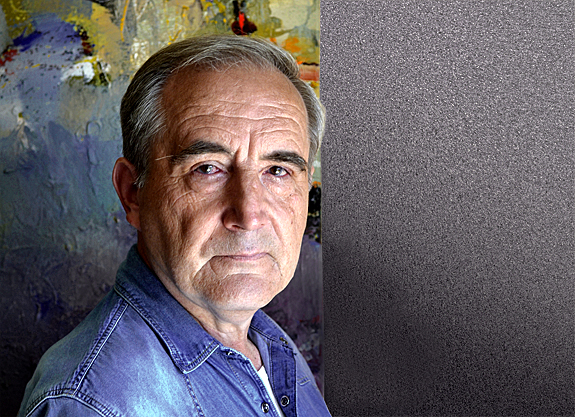
Artist Vitaly Gubarev, (Protvino)

HONORED ARTIST OF THE RUSSIAN FEDERATION
THE EXHIBITOR OF THE SALON “ART CAPITAL” 2013 – 2015
THE BRONZE MEDAL OF THE SALON “ART CAPITAL” 2015
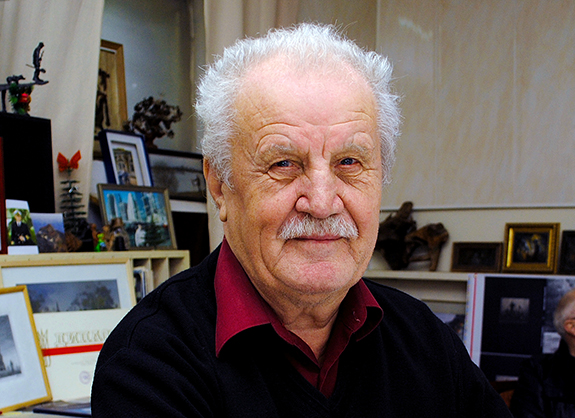
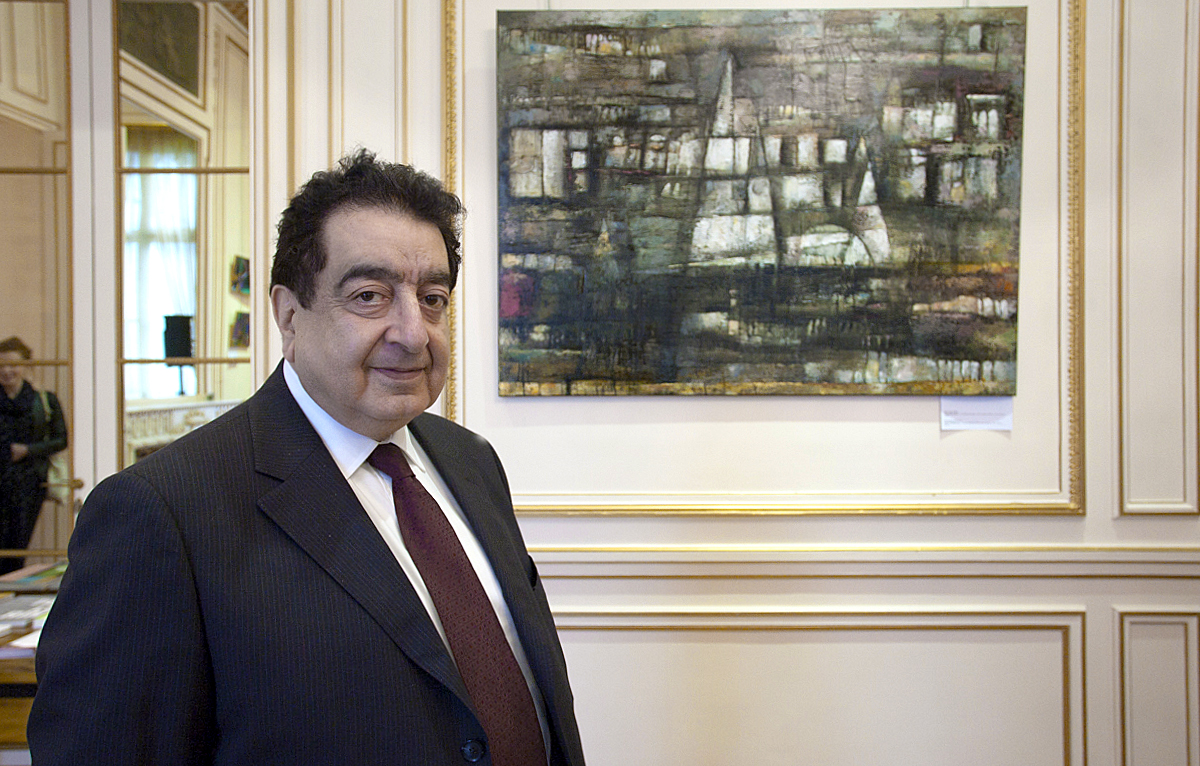
VG-Port-1

Our earthly life is a very short episode, and in eternity it is a fleeting moment only. To embody graphically an amazing flow of life which cannot be expressed in words – it is both joy and anguish. To depict an enormous space on a small sheet of paper, it takes a lot of energy. But this artistic energy returns graciously to the art viewer. In this, I see the meaning of creativity of any artist working in contemporary visual art.

Vitaly Gubarev for the readers of the ”Russian Art & Paris”.

.

.

*   *   *

VG-Port-2The art of Vitaly Gubarev is expressive and emotional. It mirrors the development of Russian graphic arts at the end of the 20th century and the beginning of the 21st century. The poetic paintings created by Vitaly Gubarev reflect the worldview of the best part of a generation to which he belongs. Up to now this generation is socially oriented. It took shape in the recent decades of the past century in the atmosphere of enthusiasm of the national gravures and great popularity of this art form in Russia. The expertise, skill, art and moral consistency of works are number one amongst the priorities in the Vitaly Gubarev oeuvre. The artist created a variety of epic and large-scale image of Russia together with the lyrical and poetical paintings. He sang of his homeland in them and pinpointed the topical issues of the public morals at all times. One of the priority themes in his oeuvre is the idea of a linkage between humanity and the world, and humanity’s moral responsibility. In such paintings, there is a warning to a spectator, the modern time, an epoch of moral conglomerate combining idealism, on one hand, and cynicism, on the other. The romantic ideals of his youth compel the already experienced and has-been artist take in hand this theme once again, search and resonate with the hearts of spectators. Vitaly Gubarev is a man of apparent value in the Russian graphic arts. He is a brilliant master devoted to the arts and he is independent and principled.
•  The narration of Vitaly Gubarev’s creative career could result in a real novel about the fate of an artist who devoted himself to the service of the arts. The activity of a master of such skill level and world outlook is worth a separate big talk and study of his methods of work.
•  The origins of the worldview of each and every human being are in his biography, in the events of years of his childhood in any way influencing shaping his views, the concept of good and evil, as well as upon the eternal mystery of interaction of a human being and the nature. Such an event for Vitaly Gubarev was his experience during the war and after war time in Uzbekistan as a child, his early self-reliance and independent thinking. All this has become the strongest motivation for studying and achieving professionalism and has developed his diligence, and strengthened his will.
•  The epic images of Russia formed in the Vitaly Gubarev’s work gradually through dozens of remarkable drawings of the Russian meadows, the newly ploughed fields and the vastness of the native Grater Moscow Area. These drawings arose asПоловодье. Протва. 30х37см-2a result of the long years and painstaking work over the series of urban and rural sceneries. To create them it took Vitaly Gubarev long years of his work. The understanding of a historical fate of Russia was lined up from one painting to another. His tours around the provincial towns, villages and rural areas of the Russian North, the Volga region and the Greater Moscow Area helped him a lot to understand it. At home, in his workshop, he understood how to achieve the maximum expression of his painting in the absent of the subject and additional details. The author’s life experience and wisdom came to him with the years entirely comply with the word picture in such drawings as «A Storm is Brewing» (1994), «The Wheats are Being Sown», -Before the Storm» (1996), «The Beginning of the Storm», «The Cloudy Day» (2001), «The First Snow» (2002), «A Field Under Wheat», «Night Field» (2003). A calm stateliness of the following drawings translates to a spectator the artist’s reflection of eternity and permanency of all in «Above theVanity» (1976), «A Field is Being Come into Ear», «The Holy Lake. The Solovetsky Islands» and «The Zayatsky Island. The Solovetsky Islands» (1998). Second place, a motive of love to the bleak Northern soil and to homeland is being evolved in these drawings. One can talk in different languages about the beauty and grandeur of the Зимний путь 21х26 смhomeland and about the love to the homeland. Here, Vitaly Gubarev found its own language that is heartfelt and very expressive. It is no mere chance, his work was repeatedly awarded with the blue ribbons by the Russian Academy of Arts, Artist’s Union of Russia and a variety of other governmental and social structures.
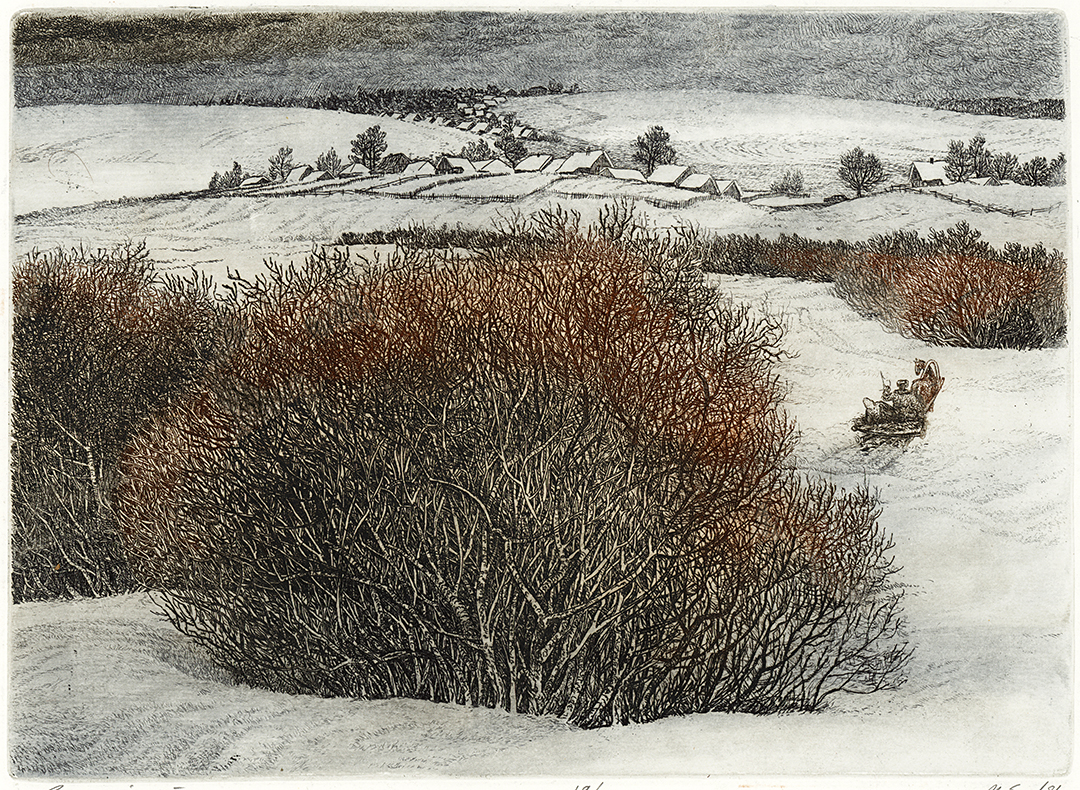
•  There are many drawings pencil amongst the Vitaly Gubarev’s best paintings. The drawing artist’s handicraft came to him as early as in his young years and yet he has been honing his skill throughout his life. Vitaliy draws at all times and in all places. He created a big collection of the easel drawings in coloured pencil that deserve attention of the museum staff as per their quality and art expressiveness. In these drawings, both the talent and high level of skill, and experience are expressed as well.
•  The graphic signature of Vitaly Gubarev is recognized as per his soft narrative intonation, as per his attentive attitude to the line, as per black and white stain, as per original rhythm that has something in common with the rhythms of the ancient Russian towns. The graphic structure of his paintings is narrative. In etching, he assigns a respectful part to the picturesque properties of aquatint giving various texture effects and helping to transfer the atmospheric colour in which the picture has been sunk. Vitaly Gubarev does like a classic etched stroke, the velvety touch of the line that is engraved in the dry-point techniques. The realistic manner in which he works all his life allowed him to achieve a high expression and brilliant skill. These qualifications put Vitaly Gubarev forward into the staff of the most interesting Russian graphic artists who are independent and picturesque in their progress.
•  Vitaly Gubarev’s engravings reveal his gift as a painter. He perceives the black and white colour graphically and in tonal shades. Apparently, a frequent address to the coloured etching and to the complicated process of gravure production with the help of several plates is connected with his perception. All his life Vitaly Gubarev does painting as well. He paints in acryl, tempera and water colour. He focuses on this art form extensively over the last years.
•  All his life Vitaly Gubarev is seeking to get an idea of the harmony of the relationship between a human being and the nature across all his contemporaries. Yury Baturin, the pilot cosmonaut of Russia, wrote from Zvezdnyi Gorodok as follows: «After a cosmonaut returning from his flight his feelings and sensations are flared up. He begins to see and notice all objects that he habitually passed by before without turning his head, especially in the nature. I saw from a new angle the beauty of common trees, rivulets and clouds on the sky after my returning from the outer space on Earth in 1998.1 saw all that objects just so how Vitaly Gubarev painted them in his pictures as «The Summer. The Protva Rivulet», «The Autumn», and etc… I have travelled around the small Russian provincial towns and common villages for several years where my antecedents lived in starting from XVIII to XX centuries. Certainly, I’m taking photograph… However, I have felt «the aura of that life» viewing only the Gubarev’s works such as «The Wintry Evening», «The Peal of Bells», «Winter», «The White Snow» and «The Rest in the Village» . These works helped me to my best understanding and feeling of those people and that life that I want to describe in my book». Really, it is rather high appraisal and one can be proud of it.

by Tatyana Boitsova,
Honored Artist of the Russian Federation,
member of the Union of Artists of the Russian Federation, art critic.

____

Pictures in the text (from above):
“High water. Protva” Etching. (30 x 37 cm); “Winter way” Etching. (21 x 26 cm).

.

.

На протве 14х18 см

“At Protva”  Etching. (14 x 18 cm)

.

*   *   *
The artist Vitaly Gubarev has long been known. A great graphic artist, a master of etching, a fine lyricist – epithets which no one disputes,  and yet, speaking about the art of this master is not so easy. The thematic range of this artist is reserved and even austere. The number of plots in his works is not too large. Add to that the natural asceticism of the techniques in etching, and it begs the question – what is the focus of the art of V.Gubarev? In what art-field does he lead his creative exploration?  Let’s try to understand.
•  We have before us two landscapes – “Blooming meadow” and “Cornfield”. The most close-up view and a wide panorama. cornfield-2Space on these sheets is strictly structured and is emphasized with several apparent tonal accents. This space, decorative and almost flat in the first case, and expanded to maximum depth in the second case, is the main character in the works. However, space can never be empty, it is always filled with something. Here we come to the most important – to the fringe beyond which art begins. A description of the space in etchings of Vitaly Gubarev is not difficult to give at first sight of these sheets – living. Living space filled with the breath of wind and the smell of grass, is vibrant and changeable. How, by what means, does the artist create this effect?
•  Pay attention to the filigree tone design, clearly visible in the composition “Cornfield”. In addition to the major tonal accents, the development of light spots of the second row literally leads the gaze of viewers through the waves of the shifting field. This is not just a tonal richness, but also an extremely difficult tonal arrangement illustrating the meaning of the work – the endless movement of living eared fields. No less interesting is the compositional solution of the foreground in etching “Blooming meadow”. The vibration of the warm afternoon air, the movement of grass, the nearly palpable smell of summer – all of this is in the construction of complex, sibling tonal rhythms of this magnificent sheet.
•  The stylistic horizon of V. Gubareva is quite wide – from the classical form of “Memories” or “Winter way” to the emotionally explosive “Above the vanity”. Today, the artist is clearly on top of his skill and actively working, so we should not rush with generalizing characteristics of works by this master. Viewers first and foremost need works of art, and not grades, of the fine artist Vitaly Gubarev. ©

by Russian Art & Paris

____

Pictures in the text: “Comfield” Etching. (29 x 42 cm)

.

.
Висячий мост 25х27см

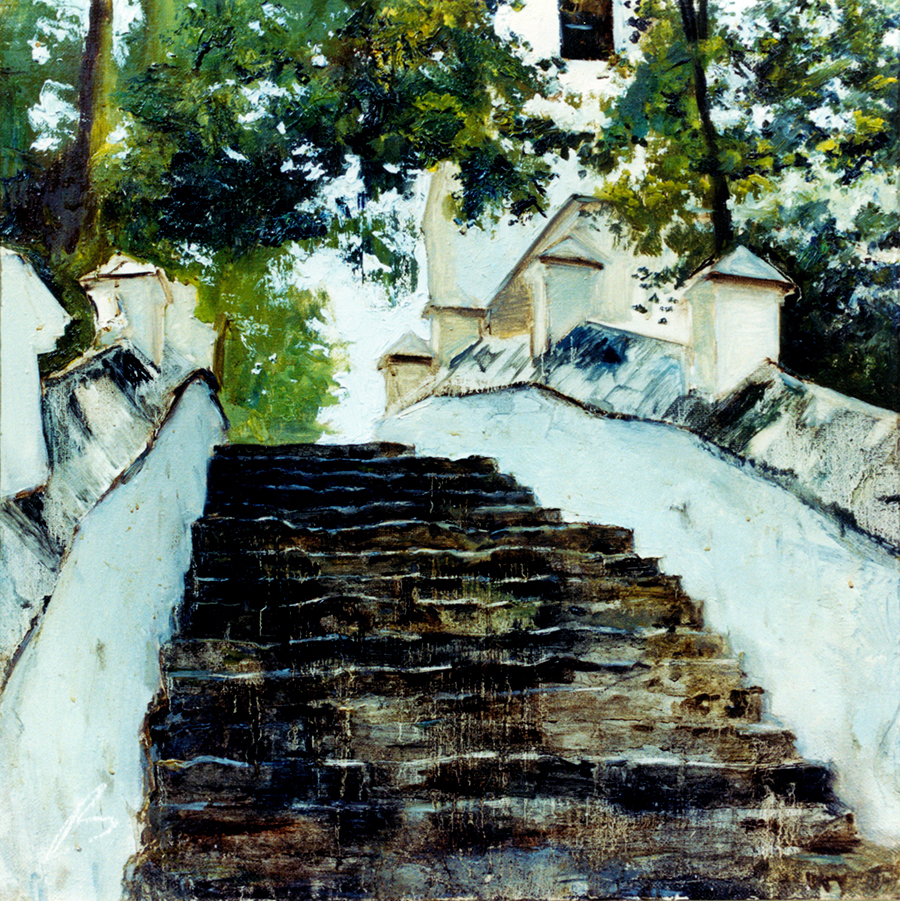
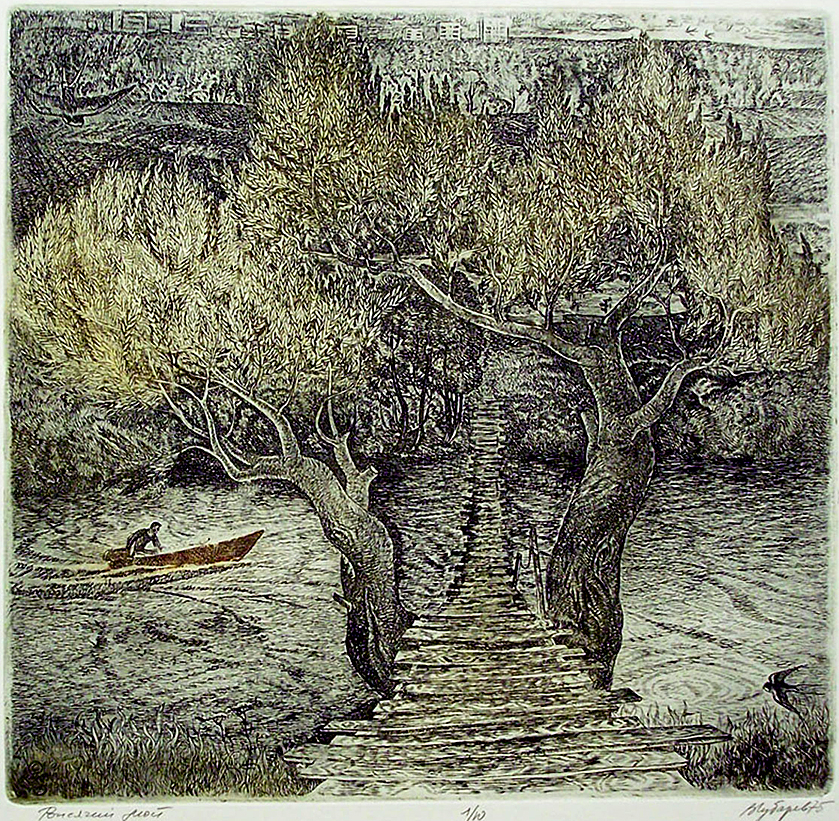
“Suspension bridge”  Etching. (25 x 27 cm)

.

Vitaly Gubarev, a graphic artist and painter, was born in 1936 in Samarkand (Uzbekistan). After graduating from the Tashkent Republican Art College (1958) he continued his art education in Moscow. He graduated from the Moscow Higher School of Industrial Art (former Stroganovskoye) in 1964. Graphic-artist Vitaly Gubarev is a member of the Union of Artists of the USSR (1971). Honored Artist of the Russian Federation (1994). Diploma of the Russian Academy of Arts (2005). Chairman of the section of graphic-artists of the Moscow regional branch of the Union of Artists of Russia (2008). Decree of the President of the Russian Federation, Vitaly Gubarev awarded the Medal of the Order “For Services to the Fatherland, II degree” (2011). Personal art exhibition in the Palace of Nations (UN) in Geneva (2012).

The works of Vitaly Gubarev – etching and graphic art are in the collections of museums: The State Tretyakov Gallery (Moscow); the Penza State Art Gallery named after K.A.Savitskiy; the Perm State Museum; the Pavlodar State Art Museum; the Serpukhov History and Art Museum; the Art Gallery of the Smolensk State Museum.

.

.

EXHIBITIONS

Gubarev-Logo-3

Etchings by Vitaly Gubarev in the exhibition of the Salon “Art Capital” 2015, (Paris). The BRONZE MEDAL 2015

.

Gubarev-Logo-1

Etchings by Vitaly Gubarev in the exhibition of the Salon “Art en Capital” 2014, (Paris).

.

AeC13-7

Etchings by Vitaly Gubarev in the exhibition of the Salon “Art en Capital” 2013, (Paris).

.

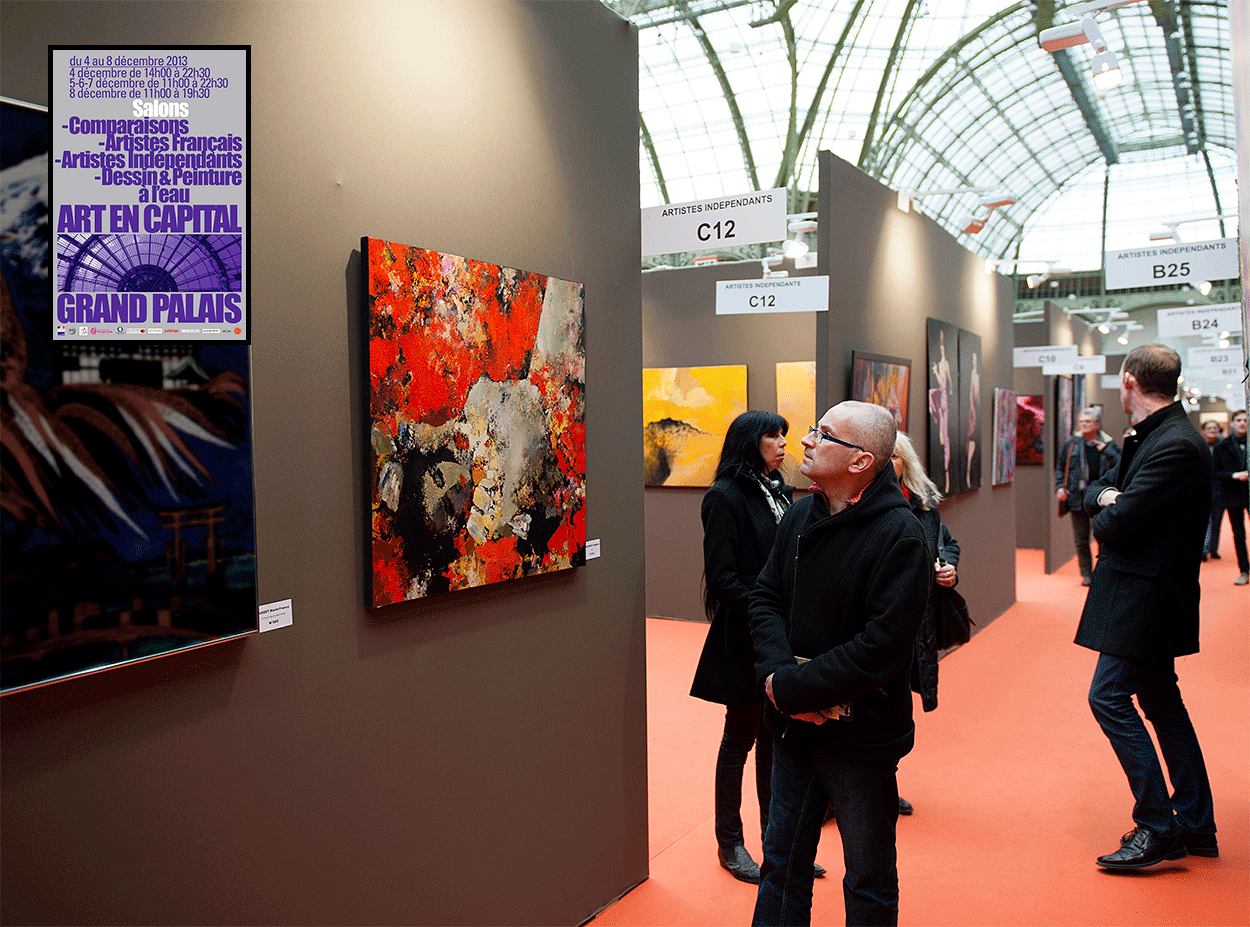
Russian B-2French B-2Gallery B-2

.

.

.

.

Russian spelling: Художник Виталий Губарев, (Протвино)

.

.

.

.

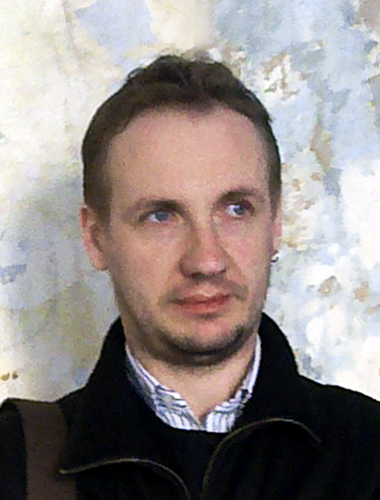
Artist Leonid Stroganov, (Saint Petersburg)

THE EXHIBITOR OF THE SALON “ART EN CAPITAL” 2013

LS-Port-BIG-5Thoughts about the visual arts lead me to memories of how I, as a teenager, loved to watch work in the port. It was in Vyborg, a small town by the Baltic Sea. I especially liked the evening. The mysterious darkness, breathing in the heavy moist sea breeze, the unintelligible subdued sounds, whistles, rattles and subtle clops, fascinated me. Wisps of the fairway, winking in the dark, created a music of excitement, the way into the abyss of a dark and mysterious Baltic night. During the day, the mystery would disappear, everything would fall back into place. Similarly the visual arts, in my view, must contain a secret within it, like a certain quality of understatement. This is what fills the work of fine art with an internal content, and transforms an everyday image into a mature and meaningful artistic statement. That is precisely what determines the value and meaning of the dialogue of the artist with the viewer.

Leonid Stroganov for the readers of the ”Russian Art & Paris”.

.

.

LS-Port-text-1Leonid Stroganov, a graphic artist, works in a currently rare technique of etching. The specifics of printmaking are historically closely associated with the art of making books, with its refined and intellectually rich aesthetic. It is quite natural that Leonid Stroganov, an artist-intellectual, not only has his own outlook, but also a brightly expressive individual style. The etching sheets of the author are filled with symbols, signs, and puzzles that engage the viewer in a dramatic art space: between truth and fiction, life and death, beauty and disorder. Every detail in his prints – is part of a surprisingly musical universe, where everything is interconnected in a complex game of semantic reflections. From this, perhaps, arises a unique rhythm, the nerve of the line of the author’s drawing.
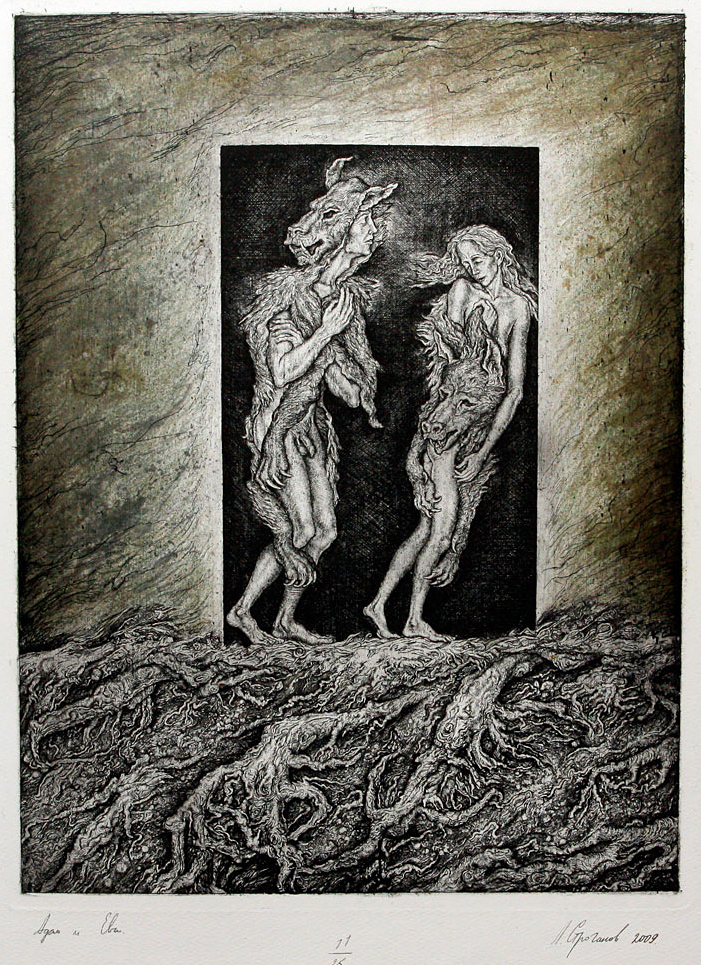
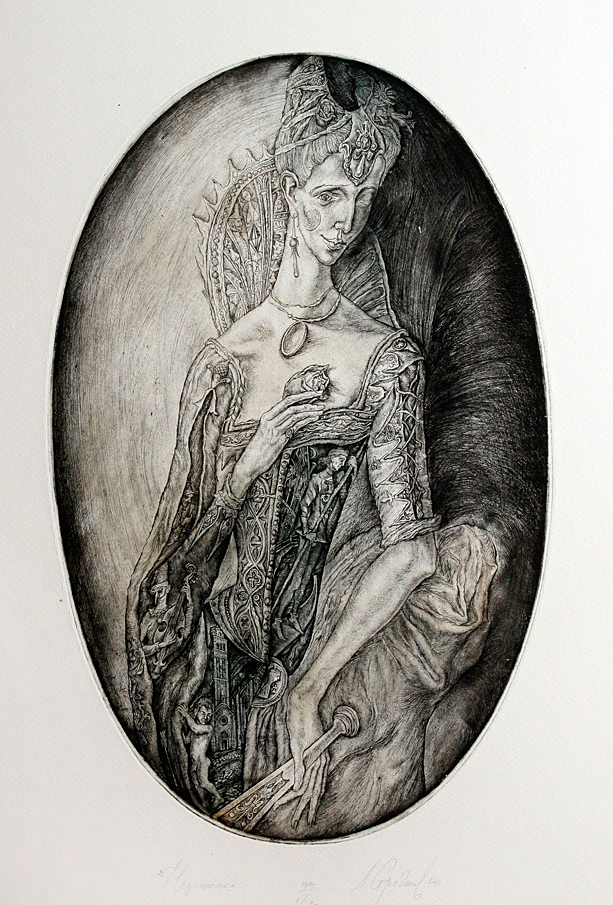
•   The heroes of etchings are fantastic, fictional personas in the image of people. The constant transformation, a rebirth one into another, is most noticeable in the early diptych “Eating” and “Running away” (2002). In later works, traces of recent metamorphosis are seen in the hands of “The Venetian”, in the face of “The Courtesan” (2010), in the feet of the bookplate of Brodovych “Adam and Eve” (2008), in the right hand “of the Magi” (2006) and in other works. These intentionally stylized techniques emphasize the belonging of the characters to a different aesthetic reality unfolded in the field of author’s myth.
•  Series “The Silence” (1999) – is one of the first made by the author in the technique of etching. In this series, which is mysterious and surprisingly melodic in a youthful way, the third sheet is of particular interest. On a gloomy background of deep space there are nude, separately seated figures of a man and a woman with a baby sleeping peacefully in their arms. Immersed, each in their own world, both he and she are alone. Above them, in the upper world, submitting to their own music, unseen creatures fly on a predetermined path, and in the lower world, listening to the melody, wonderful fish swim by. He and she are in an infinite space, where everything is on a predetermined path. The juxtaposition, in which a LS-Port-text-2man and a woman are in the third sheet of the series “Silence,” occurs in the author’s work more than once, for example, in the previously mentioned bookplate Brodovych “Adam and Eve”. The small size and chamber genre of the bookplates do not stop it from being one of the artist’s strongest works – the engraving is beautiful in its artistic idea and deep in meaning. Heroes of a biblical myth are depicted lying on the roots of the tree of knowledge of good and evil, they are arranged with their backs to each other. Adam and Eve are close, but not together – they are far from each other. The audience’s glance at the lying down lonely and confused characters creates a special sense of the timeless existence of personas.
•  Leonid Stroganov returned time and again to the first people of the world. Several works were made with the plot of “Expulsion from Paradise”. Two large-sized works were completed by the author in 2009. One of them depicts Adam and Eve in the moment when they leave the gates of heaven. A huge portal is framed by two dark figures, wrapped in donkey skins. They walk side by side; their closed faces and expressive gestures speak of desperation. They wander along the same road, but each has their own skin, every person for themselves. The author reveals through this Biblical story, the theme of human loneliness. The second work on the same LS-Port-text-4subject, in the form of a diptych, is striking by its expression. Adam and Eve appear emaciated by suffering and eternal journeys. In all the works on the theme of the Fall, an important place is devoted to the image of a root turned inside-out from the land, or of roots blanketing the ground. The root is a metaphor for the origin of that which is hidden from the eyes, which gives vitality.
•  A particular perception of time is present in many works of Leonid Stroganov. The author builds his work in such a way that his characters still exist timelessly, even if the text is full of symbols and attributes that refer to a particular historical period or literary composition.
•  Travelers wander timelessly on their way from the cycle “Moving” (1999). On one of the sheets of the series of the same name, under number one, a group of people is depicted under a starry sky. The wagon, a boy with a backpack, people in hoods, a woman holding a baby next to a man, all wandering after a donkey. Who are they? Refugees, pilgrims of the Middle Ages, whose life was on the road? Unwittingly, you pay attention to the last figures: “A donkey, a woman with a baby, and the man nearby”. The combination is perceived as a quote: “Holy Family on the way to Egypt.” But the woman is not sitting on the donkey, but follows him, and the face of “Joseph” is hidden under the mask. A Miracle – in the ordinary flow of life, but it cannot always be noticed and understood. In the artwork there is no emphasis on the faces of characters. Perhaps they have not yet found their persons, have not found their identity. Through the procession, attention is drawn to the figure of a teenager carrying a load on his shoulders, precisely because he has a face. The boy with the backpack is similar to the artist himself. Does this mean that he walks among his characters behind a cart along a road in the flow of people? There is a feeling of not only a myth, but also a parable. There is a special feeling of a mystical-philosophical “Stroganov” aura, which is the hallmark of the work of this young and very talented artist.

by Ksenia Harina, art critic.

.

Адам и Ева

“Adam and Eve”   Etching. (40 x 30 cm)

.

*  *  *
The modern Saint Petersburg graphic artist Leonid Stroganov debuted in art with an impressive series of etchings “King Lear”. The sophisticated viewer will immediately feel a dissonance because a series of etchings requires quite serious creative experience and of course, maturity is needed for Shakespeare… All right!  And yet… The talent of Leonid Stroganov is bright and obvious. Few artists of this age have an established style and a distinct artistic vision. Even rarer is the wholeness and strong inner conviction of his own truth. These are imperative qualities without which many talents have faded.
•  The bas-relief style of Leonid Stroganov etchings, their intense drama, is realized in full effect in the William Shakespeare series. No less interesting is the dynamism of compositional solutions, the amazing artistic unity of tonal and rhythmic rows. Tonal accents impeccably build the dialogue of gestures in the etching “King Lear – 1″. The complex range of emotions in the sheet of “King Lear – 10″ comes from the black and white rhythm of the composition. The determination and non-triviality of the compositional structures of each sheet is very enticing. Determination, without which it is impossible to create a new artistic image or, by the description of philosopher N.Berdyaev a “creation of the nonexistant”.
•  A series of urban landscapes of St. Petersburg – the city, roadway of which have seen each and every Russian artists, is a difficult task for a master of any rank. For a series, it is insufficient just combination of scenes. It is very essential to have a new quality – the Saint Petersburg of Leonid Stroganov. And on the etching plates of this artist, such a city arises. This is not quite an ordinary St. Petersburg. Dostoevsky is not seen on its bridges, but perhaps Bulgakov may appear just around the corner. This city is still tragic at night, but a little provincial in the light of day. This is a different St. Petersburg. A St. Petersburg through the eyes of an artist from a new generation. This city can be liked by not everyone, but it already exists, because there exists a new and intriguing artist – Leonid Stroganov.  ©

by Russian Art & Paris

.

Куртизанка

“The courtesan”   Etching. (42 x 28 cm)

.

Leonid Stroganov was born in the city of Saint Petersburg in 1979 year. After graduating from the Saint Petersburg Art College named after Nicholas Roerich (1999), the artist was continued his education at The Institute of design, applied arts and humanities under the guidance of the Honored Artist of the Russian Federation Oleg Yahnin (2002). Since 2002 he is a member of the Artists’ Union of the Russian Federation. The artist-graphic Leonid Stroganov lives and work in Saint Petersburg, Russia. 

.

.

EXHIBITIONS

AeC13-8

Etchings by Leonid Stroganov in the exhibition of the Salon “Art en Capital” 2013, (Paris).

.

.

Russian B-2French B-2Gallery B-2
.

.

.

Russian spelling: Художник Леонид Строганов, (Санкт-Петербург)

.

.

.

.

“Russian Art & Paris” Art Show. Summer’13

In the Summer’13 Art Show of the “Russian Art & Paris” journal, we present to our readers four very interesting contemporary artists of different styles and genres. They include – a young and very talented artist Alla Polkovnichenko from Moscow, just beginning her career as a professional painter. As well as three well-known masters in the world of fine art – St. Petersburg artist Viktor Egorov, painter Alexander Shevelev from Rybinsk and painter Guennadi Ulibin from Seville. An uncommonly wide range of creative techniques and artistic decisions, and the bright originality of each of these artists will attract the attention of all who follow the development of modern art.

.

.

*  *  *

ARTIST VIKTOR EGOROV, (SAINT PETERSBURG)

VE-Port-1In the endless discussion about the fate of landscape painting, there constantly sounds, like a refrain, the philosophical and aesthetic justification of the existence of this genre, its right to an independent life. What exactly causes such a cautious attitude towards it? Could it only be the relatively short history, compared to other genres, or is it something else? Perhaps the complexity of the creation as well as the interpretation of the artistic idea, the fuzziness and uncertainty of the very concept – “an artistic idea of the landscape,” are the primary basis for these doubts. Let’s try to approach this issue from the position of the artist. Why does the artist turn to this genre? Which aspects of the potential of the landscape genre seem more significant to him in comparison with other genres? The artwork of one of the modern masters of landscape art, Saint Petersburg artist Viktor Egorov is quite an appropriate occasion for such a conversation.
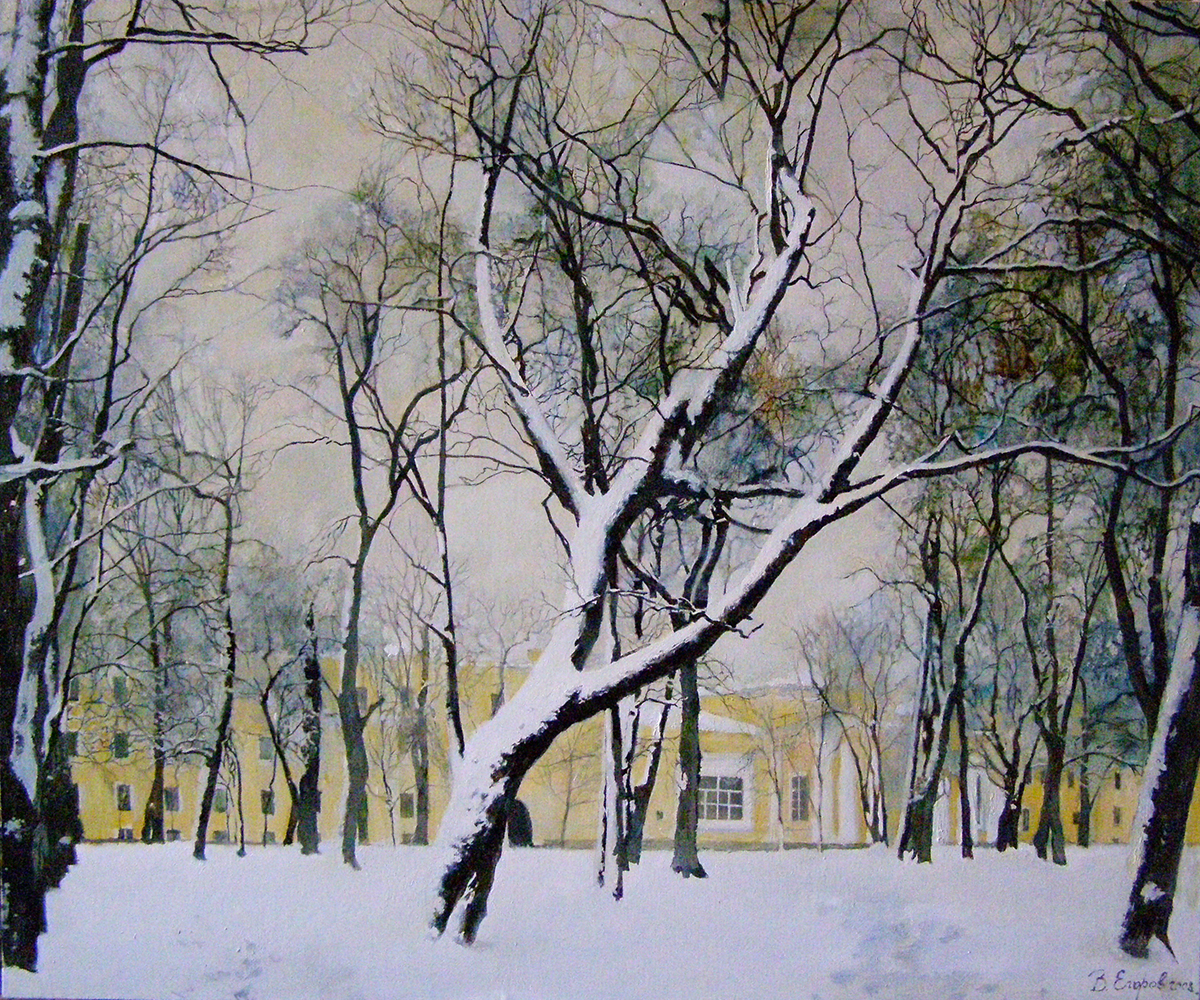
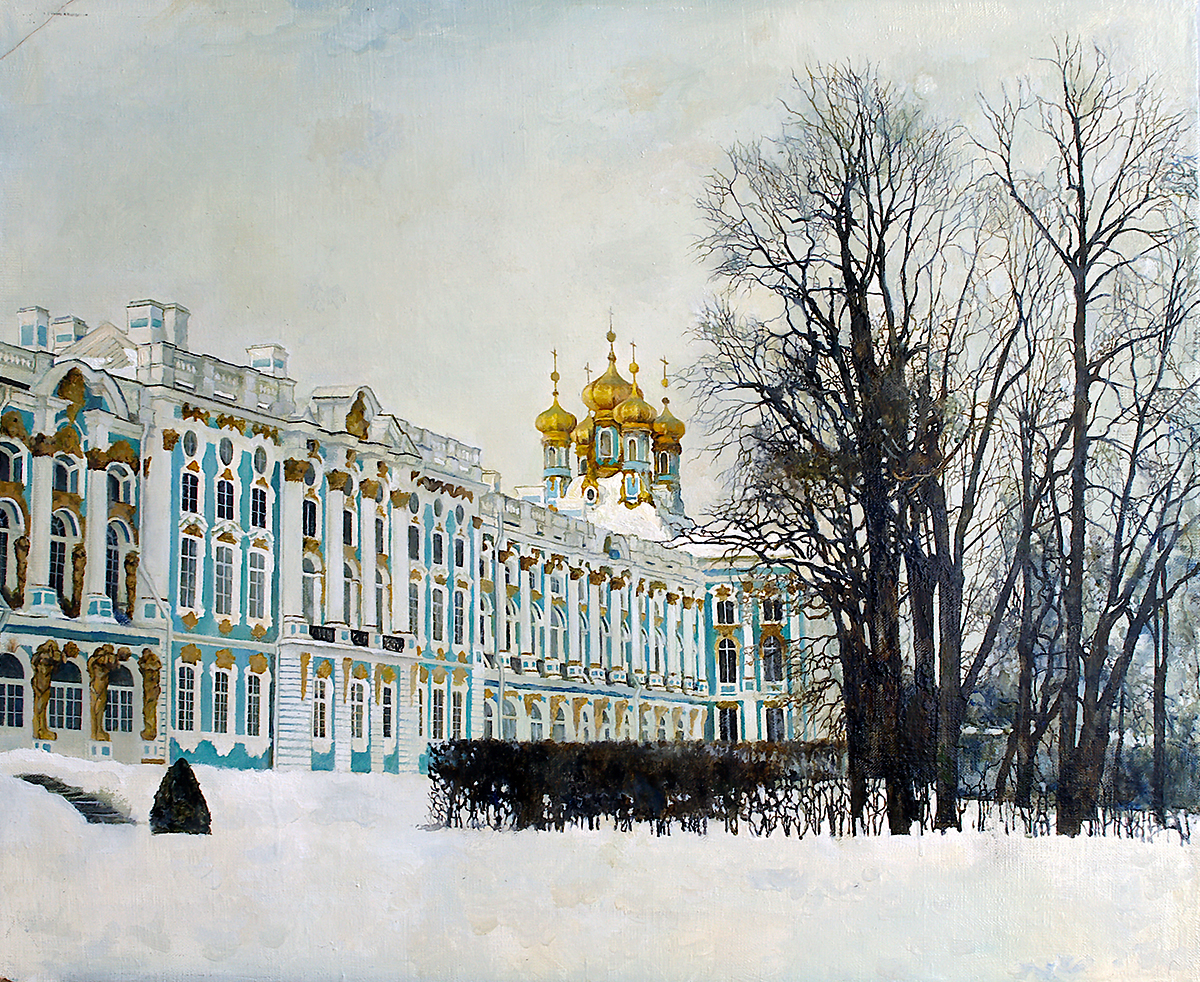
•  The meaning of landscape as an artistic composition is mainly associated with the organization of space. The compositionally motivated plot, the spatial rhythm, perspective, all of these are basic landscape components focused on solving a single task – creating the spatial structure of the image. The emotional order, the “melody” of the work itself is created (or not created) during the stage of solving compositional (structural) problems. In the paintings of Victor Egorov the tradition of the classical landscape with a construction of space to a considerable depth are masterfully implemented in a series of urban winter scenes – “Tsarskoye Selo”, “Kryukov Canal,” “St. Nicholas Cathedral.” With the classical tradition of this artist’s work, there is a link to a high degree of generalizing a theme (“Winter Garden,” “Autumn in the Park”). The complex rhythm of trees – in depth and horizontally, in conjunction with the restrained coloring, create a graphically expressive image-sign. Thus, the landscape begins to take on portrait characteristics – portrait of autumn, portrait of winter. This portrait features are extremely significant. Landscape –  is an aesthetic notion. Landscape – is a natural or urban terrain seen through the eyes of man. This means that the landscape only exists as an VE-3image, a generalized image of the world around us. In his most significant artworks, Victor Egorov successfully creates a landscape image-portrait.
• Very interesting are the works of the artist associated with horizontally expanded compositions of the landscape (“Birch”, “View of the Palace of Peter III”). The calm, clear, rhythmic structure of the composition creates a metaphor for a quiet state of motive – the structured construction creates a melody. Similarly, the horizontal rhythm, but more complex and rich, is wonderfully designed in a classically beautiful scenery – “Chinese Palace” (the second part of the triptych “Oranienbaum”). The distinct pulling of Victor Egorov towards large art form, symbolization of the plot (unlike the intimate lyrical narrative); these are the distinctive features of this master’s work. At the same time, these features are in conflict (in some artworks) to the over-naturalization of the object’s image, creating a stylistic dissonance. The phenomenon in general, is very characteristic of contemporary fine art.
•  The development of the artist within his work is always a mystery. A mystery, for him as well. Of particular interest is the fact that the development of this intrigue happens in front of the audience – the passive, but influential members of any artistic process. The artwork of Victor Egorov is far from its peak. How and in what direction will this development take place remains to be seen, but what has already been created is a clear indication of the arrival of an interesting and extraordinary master. ©

by Russian Art & Paris

____

Picture in the text: “Svyatogorsky monastery”  Oil on canvas. (65 x 70 cm)

.

OLYMPUS DIGITAL CAMERA

“Winter garden”  Oil on Canvas. (55 x 60 cm)

.

OLYMPUS DIGITAL CAMERA“Autumn in the Park”   Oil on Canvas. (50 x 60 cm)

.

Царское село.х.м. 50х65 2006г.“Tsarskoye Selo”  Oil on Canvas. (50 x 65 cm)

.

.

Russian B-2French B-2Website 4 (RAP)

.

.

.

.

.

.

*  *  *

ARTIST ALLA POLKOVNICHENKO, (MOSCOW)

AP-Port-1“Understanding the real world – is the process of creating its models” (A.Kerzhenova). The artistic reality of the painter Alla Polkovnichenko is a vector model that sends the viewer not in the direction of empirical reality, but in the exact opposite direction. In the direction away from the “objective” world and towards the subjective interpretation of it, where as a result of the creative search, there arises a strange and unusual creation – a symbol-sign. The visual code, which is information-sensitive, allows us to justify that before us is fine art, and that art is authentic.
•  The open world of the artist Alla Polkovnichenko is huge and simple. The movement of clouds in the sky (“Cloud Coming”) and the movement of the human soul (“After the Rain”) in this world are equivalent and meaningful. The philosophy of this space is intertwined with the philosophy of human destiny, visibly or invisibly present in every composition (“Big City”, “Elets”, “The Banks of the Don”). The vivid metaphor (“Water Tower”) and the detailed narrative in the style of an urban romance (“Olga”, “Pedestrian Zone”) do not contradict each other, but are merely blocks from which the viewer can build any picture of the world by his own directive. The one which he likes…  A few features fit naturally into this picture of the world: the “Night”, naive but made a with double supply of irony, and an earnest attempt to understand what is in this world (“Self-Portrait with a plaster head”). A rare in contemporary art, sensual direct view of the world, reveals the identity of the person and the environment, enlightened by his presence (“Resurrection”, “Self-Portrait with a Curved Mirror”), where the depth of space disappears because space, as the distance is just our illusion. The suppleness of the plot, the incoherence of its own artistic monologue by a story (“Rural Love”, “Natasha reading”) are a natural consequence of inherent talent and the learned ability to see. To see that what exists.
• The aesthetics of Alla Polkovnichenko contains a minimal number of basic components. The exquisitely complex AP- Lenastructure of the coloristic composition in combination with the carefully developed tonal-rhythmic order create the main “melody” of the work. Artwork detailing – both compositional and picturesque – is almost nonexistent. It is essential to note the absence of explicit tone-color accents – evidence of the professional and aesthetic maturity of the artist. The division of the composition into planes, which come in the form of mixed space – are probably the most interesting compositional technique in the arsenal of Alla Polkovnichenko. A technique, which the artist wields perfectly and with a sense of measure. As for the static compositional solutions, in the vast majority of cases, it looks more like a step in the development than a sensible creative choice.
• The talent of an artist – is always potential. To speculate how this potential will be realized is useless. We will see everything that will take place. But from what is seen in the work of artist Alla Polkovnichenko even now, there is a very characteristic distinguishing feature of great talent – conviction. “Once and for all exactly right and just as it is.” ©

by Russian Art & Paris

____

Picture in the text: “Lena Palenko”  Oil on canvas. (75 x 100 cm)

.

AP-After the Rain-2“After the rain”  Oil on canvas. (75 x 55 cm)

.

AP-3-text“Cloud coming”  Oil on canvas. (135 x 150 cm)

.

AP-2-text“Olga”  Oil on Canvas. (165 x 104 cm)

.

.

Russian B-2French B-2Website 4 (RAP)

.

.

.

.

.

.

*  *  *

ARTIST ALEXANDER SHEVELEV, (RYBINSK)

ASh-Port-1Beauty is inherently subjective. Within this subjective space, the dramatic world of fine art is unfolded. The artist exists in this world all the time, not being able to venture beyond it, but being able to push the boundaries of this world – his own art creative space. Defining the creative space of artist Alexander Shevelev is not difficult – his creative declaration, distinct and clear, consists of dozens of excellent artworks, with no puzzles remaining after looking upon them. That which is loved by the artist, that which caught his attention, is all in front of us; it is enough to just see these artworks. Nevertheless, during careful contemplation of paintings by Alexander Shevelev, questions arise that are quite interesting and deserving of us to dwell on them in detail.
•  Plein air sketch – the main and most reliable tool for the landscape painter. The bewitching charm of a successful full-scale plein air sketch is familiar to every lover of painting. Studio (easel) artwork – the picture – is not just another artistic form. Studio picture requires a quite different kind of visual language. Work at the junction of the two forms – plein air sketch and studio painting, a synthesis of categories that are inconsistent at first glance – are the main fields of the creative search of artist Alexander Shevelev.

•  When analyzing features of the artwork by this particular artist, and defining characteristics of his pictorial techniques, we should first of all mention his work with foreshortening. Panoramic perspective, well-known in the visual arts – is a rare guest in the compositional arsenal of the modern artist. The epic sounding of such compositions, their vulgar pathos, is discouraging. The works of Alexander Shevelev: “Spring in Rostov” and “Solovki. Rigging warehouse”- a rare and exceptionally good examples of panoramas with an intimate lyrical melody. The combination of plein air style and panoramic form creates a new artistic quality of painting. An even more interesting angle, so to speak, a “telephoto-style view” – is a look from long range with a significant coverage of Март в Шереховичахimage in the vertical dimension: “Autumn in Borisolebsk” and “March in the village of Sherohovichy”. The unexpected foreshortening is a surprise, a strange glance at the world that logically motivates an unexpected detailing of the image in these artworks.
•  The coloristic origins of painting of Alexander Shevelev are naturally linked with the plein air sketch, which the artist wields freely and masterfully. The tense, sometimes reinforced colors are the trademark coloristic handwriting of the artist. The concentration of color itself does not always lead to the concentration of the meaning. The essence of beauty in its coloristic value mostly manifests itself through harmony. Plein air works of the artist of recent time (“Sledge”, “The Yard”, “March Snow”), in this regard are practically flawless and by their artistic merit do not give way to the studio paintings of this master.
•  Foreshortening, composition, color – are categories of form, which in turn is the bearer of the artist’s individual aesthetics. The value of this aesthetic is subjectively determined by the viewer and can change over time, sometimes significantly. The subjective character of beauty and the subjectivity of viewers’ estimates are of the same nature. However, the artwork of Alexander Shevelev exists objectively – the process of creating and developing his own art form, of his own artistic language. A language that is unusual, vivid and memorable. ©

by Russian Art & Paris

____

Picture in the text: “March in the village of Sherohovichy”   Oil on canvas. (50 x 60 cm)

.

Осень в Борисоглебске“Autumn in Borisoglebsk”  Oil on Canvas. (80 x 98 cm)

.

Весна в Ростове“Spring in Rostov”  Oil on Canvas. (41 x 85 cm)

.

Весна 75 x 100 сm“Spring”  Oil on Canvas. (75 x 100 cm)

.

.

Russian B-2French B-2Website 4 (RAP)

.

.

.

.

.

.

*  *  *

ARTIST GUENNADI ULIBIN, (SEVILLE)

GU-Port-1

In the history of artistic movement known as mystical realism there are few names and creative events (the term “mystical realism” was introduced by the German art critic Franz Rauh to describe the picture, which shows a changed reality). Work within the boundaries of this area brings quite unconventional requirements to the author: a high level of artistic skill – to create such a composition, and a no less high intellectual level so that the creation become a work of art. Such combination of these qualities in art is rather rare. Modern audiences raised on the centuries-old tradition of perceiving the artist as a bohemian and refer to the phrase “artist-intellectual” with a natural suspicion. Such is the tradition, or, if you will, that is the reality, and few dare to challenge reality. Artist Guennadi Ulibin is one of the few.
•  “The rate at which time passes for an object depends on its velocity relative to the observer, as well as the strength of the gravitational field, which can slow the passage of time.” The very appearance of such a quote in an essay on the work of the painter can result, at the very least, with eyebrows raised in surprise. Meanwhile, particularly this quote most fully reveals the central theme of the work of Guennadi Ulibin, the subject of space and time. The attractive force – gravity, in the plots of Guennadi Ulibin is irrationally huge. Objects are literally pressed into the surface of the planet. As a consequence – the passage of time has almost stopped. Can anything even happen in a space with fixed time? Perhaps yes, and even something quite interesting. First of all, things in their ontological value return to their original meanings – the stones are just stones, the tide is a tide, the sunset is a sunset. But the most amazing transformation happens with man. Freed from their social camouflage, man – an object that is familiar to us all, is recognized with difficulty. Is it really true that we, people – are like this? Let’s not rush to answer.
•  The space in the paintings of Guennadi Ulibin is one of the main components of the artistic image. A distinctive feature, quite unusual for a work of art, is the depth of this space. In the paintings “Earth”, “Space”, and “Ocean”, the scale is almost Сонphilosophical, to the very boundary of the knowable. The stillness of the characters is deceptive – every pose is distinctly accented by a gesture (the turning of a head is also a gesture). In this regard, it is interesting to recall a thesis by Pavel Florensky – “the gesture defines a space therein causing tension and thereby distorting it.” The distortion means the subordination of space, its individualization. This is yet another feature of the works: the complete and absolute proportionality of the size of the space to the size of man. This proportionality is not accidental, the humanitarian environment of man – the whole planet, is one and indivisible. The man and the planet are identical. This identity is affirmed by each composition of Guennadi Ulibin.
•  The external monumental visual style of Guennadi Ulibin should not be misleading – the key of his works is the human dimension and the human element. Both the spacial and the metaphorical compositions are interpreted by the artist within the human destiny. The semantic content of human images partly resonates with the fundamental idea of Nietzsche’s “eternal return”.  “- Oh, the man always returns!” spoke Zarathustra, but the man does not always returns the same, as he was before. Is it possible that from the depths of the images of artist Guennadi Ulibin the man looking at us is an unknown “new” person, or at least a sketch to his portrait? Why exactly is it impossible? ©

by Russian Art & Paris

____

Picture in the text: “Dream”   Oil on canvas. (89 x 196 cm)

.

Безлюдное пространство“Unmanned space”  Oil on Canvas. (81 x 162 cm)

.

Океан“Ocean”  Oil on Canvas. (195 x 100 cm)

.

Вода“Water”  Oil on Canvas. (89 x 195 cm)

.

.

Russian B-2French B-2Website 4 (RAP)

.

.

.

.

.

Artist Vladimir Shichkov, (1951 – 2016)

THE EXHIBITOR OF THE SALON “ART EN CAPITAL” 2013 – 2014

VS-port-1-4 bigThe Arts – are fragments of a lost paradise, and the task of the artist, is to try to collect them. The difficulty lies in the fact that art is not life itself, but rather its reflection. Attempts of a literal copying of nature in painting do not reach a result, because the real-life object and its image in the plane have a different nature. In the 20th century, art has significantly transformed: in addition to the indisputable realism with its deep penetration into the essence of being, there is now impressionism, with its elements of pure color, and also the avant-garde with its innovative formal quests. I’m interested in the stylistic achievements of each of these areas: they complement and enrich one other. The main aspect of art – to create works that could “hook” the soul of the viewer, stop it, and make them think. Particularly this event – the pause before any artistic canvases, instantaneous concentration of attention on painting, transforms a participant of a gallery into an audience. The most valuable of all things is our life. Humans are given a unique opportunity to explore the world, to think, to dream, to love, and if they are also given the gift of creativity – it is a huge responsibility, as if every artist comes into this world with a certain mission. Another and very important thing – has he realized it or not, has he understood himself, has he received the necessary proficiency and the ability to clearly express it …  At the end of it all, for his own creative talent, he is personally responsibility before God.

Vladimir Shichkov for the readers of the ”Russian Art & Paris”.

.

.

VS-port-2In the present, there exist many artists, preserving the traditional commitment of art, but being absolutely modern in their worldview. Their artwork in which there is a free transformation of natural forms and a subjective interpretation of the visible, acts in opposition to the naturalistic paintings of the recent past, which imitate the lifelike. The figurative meaning of paintings by such masters is difficult to comprehend. The artist seeks not to as much visually reconstruct objects as to inspire viewers with artistic images, to cause a certain mood. Departing from external naturalism involves the activation of a counter spiritual perception from the viewer. The depiction of expression in these canvases, dominates the goal of portrayal. The drastic emancipation of painting from the tasks of fable narrative requires updating of the language of depiction.
•   Such work is done by artist Vladimir Shichkov. His artistic formation and development, it would seem, did not foreshadow this turn. For years, he repeated the fate a painter quite traditional in subject matter and in style. Apparently, it could hardly be expected from him to have drastic changes in both. But the era of rapid shift of the entire political and cultural life of the country has awakened many. Almost complete cessation of state patronage in the arts freed artists from the persistently imposed criteria. Vladimir Shichkov was sensitive to the challenges of the time.
•   From imitation painting, visibly object-based, he came to the artistic decisions, residing at the boundary of a complete loss of natural object. The reduction of material forms as if not at all hinders the master. On the contrary, it seems to him as a particularly attractive way to strain the viewer, to give him the possibility of different interpretations of what he saw, but within the originally specified emotional range, as is the case with the experience of musical tune. The boundaries of possible interpretations are deliberately vague: the artist emphasizes the emotional beginning, not the figurative meaning. In the internet age, the visual culture of the viewer fundamentally changes. And above all, it concerns the extraordinarily sped up pace of showing. Flickering frames, the surprise and showiness of viewing angles, dissonances of color, blurring of contours – all this has become natural and habitual to the modern man. The view from the window of an express train or a speeding car, significantly changed the way we experience the world, and could not have avoided the visual arts.
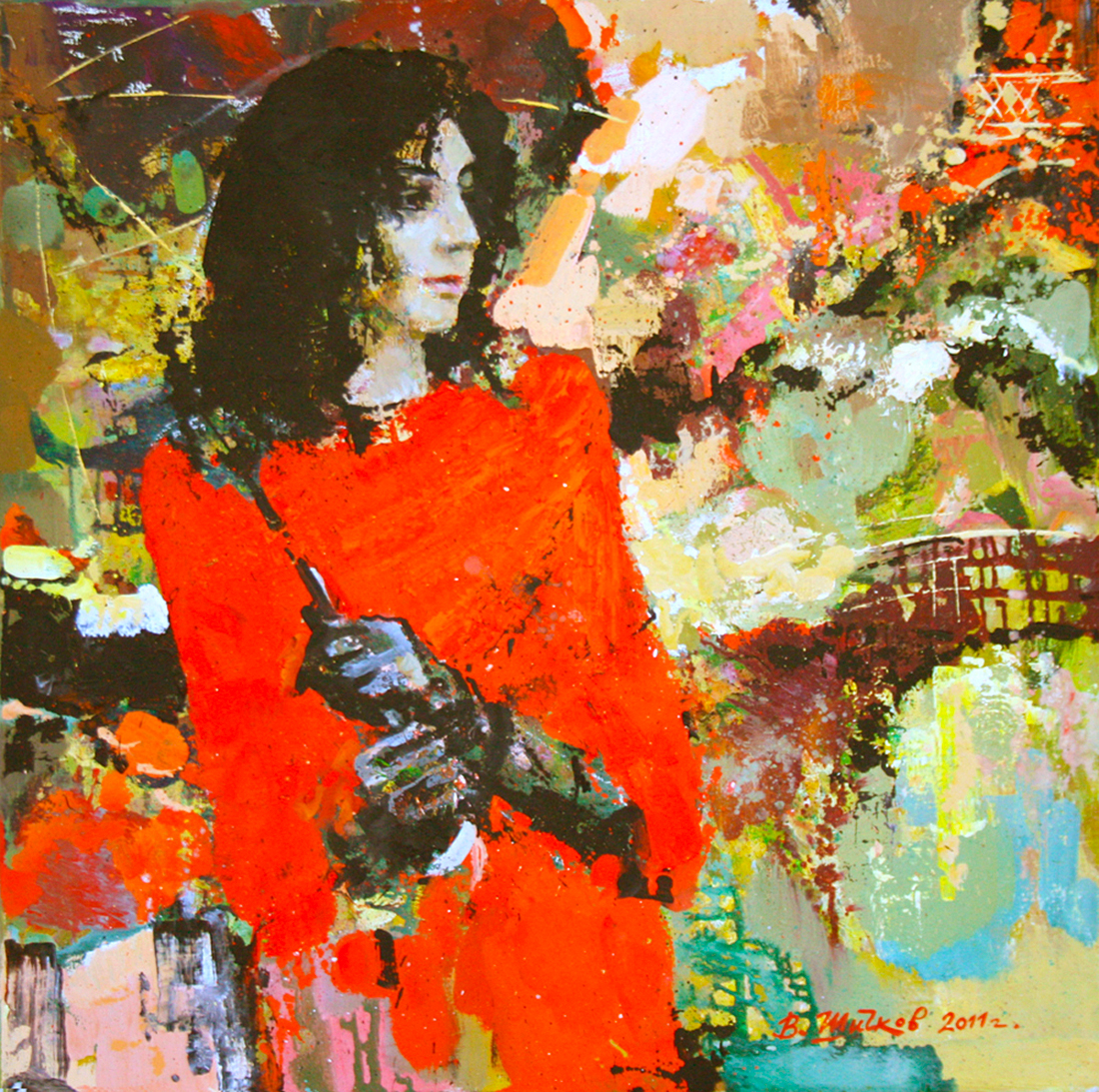
•   His paintings sometimes differ from the natural world. These artworks Breakfast-2 Small 40x60PUSHAVKA_60X80ignore the density, weight, and material tangibility of the portrayed objects. Vladimir Shichkov attains an associative resemblance with the object, working largely in favor of his own enacted fantasies, freely transforming the outline, color palette and texture of objects in any motives. Hardly marked outlines, the quaint and moving kaleidoscope glow permeated by vibrating color stains, give birth to a special aesthetic emotional vagueness, a fleeting illusory, “where precision is fused with fluctuation” (P.Verlen), unwittingly awakening our imagination as well. These canvases are viewed as more flattened, they delineated a decisive turn to pure decoration. The unique features of this artist’s creative style are: improvised variations of bright imaginary landscapes; fragile, transparent silhouettes of flowers; demonstrative artistry of writing; cursory informative content of the plot; free emotional response to what is seen; expressive movements towards heightened-color painting; quite flawless artistic intuition.
•  In a recent review of his solo exhibition at the Ivanovo State Art Museum, it was not accidentally said: “The artist balances on the verge of figurative painting and abstraction – a fascinating act of equilibrium.” Note that this is not without reason. The coloristical intensity of the canvas is held by the clashes of the thoughtfully rhythmic decorative spots. This reinforces the intensity of perception of the almost intangible materiality barely showing through the figurative motif. It seems as if the artist paints colored light, creates a luminous painting on glass – a kind of stained-glass feature to his paintings markedly magnifies their decorative-poetic beginning.
•  All of his work, labeled by critics as “artistic equilibrium” seems like a spontaneous outburst of emotions carried onto the canvas at a rapid pace, executed in a live sketch-like manner; but such an impression can be misleading. By his own admission, they were born painstakingly. They were not a freestyle improvisation, but rather a deliberate desire to make the image and its perception by the view more dynamic. While seemingly without structure, these paintings are well made and designed to fulfill their main function – become an emotional dominant of residential or office interiors. Hence the desire for the external showiness, color harmony, and predominately sunny disposition of the emotionally-shaped structure.
•  Honing his individual style, the master creates many paintings varying on the theme of color richness of the visible world. Vladimir Shichkov artistic creativity increases markedly from year to year. A direct appeal to the legacy of Impressionists or the quest for the artistic avant-garde are characteristic of the era of postmodernism: poly-stylistics become the style of our time. Today’s avant-garde artists actively make use of the achievements of predecessors. Already in the 1910s avant-garde started becoming more academical and there originated an avant-garde salon, which in our time decisively wins the sympathy of the audience, contemporary art galleries, and private painting collections. The achievements of Vladimir Shichkov are a visual confirmation of these tendencies. The processes of globalization are truly planetary in nature and necessarily pull into its orbit of influence even the most remote corners of the Earth.

by Efim Vodonos,
Honored Artist of the Russian Federation,
Director of the Russian art department of the Saratov State Art Museum
named after A. Radischev.

.
____

Pictures in the text (from above):
“Breakfast” Oil on canvas. (40 x 60 cm); “Pushavka” Oil on canvas. (60 x 80 cm).

.

.

Paris 2“Paris”  Oil on Canvas. (70 x 70 cm)

.

*  *  *
Thinking about the aesthetics of Vladimir Shichkov, noting how precisely the color chords of his works are composed, the term “poetry” involuntarily comes to mind. Concepts, which are used in the theory of poetry seem to be quite adequate for the artistic analysis of the pictorial composition of this master. Rhyme is a measured pace, the rhythm of sound. This definition is most relevant to the creative work of Vladimir Shichkov. The rhyme of color is at the foundation of his amazing and exceptionally attractive artworks.
• Let’s look at a little artistic miracle – “The Indian Summer”. Or at the no less charming – “The Flare” and “The Morning”. What is special about these compositions, which at first glance have quite ordinary plots? Is the innovative character of the artwork? Sure. Excellent color scheme? Absolutely. But apart from these purely artistic aspects, there is another dimension that is absolutely humanitarian – humanity. Peering into the coloring of paintings by artist Vladimir Shichkov, listening to the monologue of his paintings, the conclusion has to do quite unexpected. These bright, juicy, and externally flashy pictures lead their conversation with the audience in a surprisingly calm and warm voice. What gives them such a sound? First of all – the rhythm, the movement of the main color harmonies in the plane of the visual field. In the brilliant landscape “The Indian Summer” this can be seen most clearly. The rhythm of the main color masses with perfect precision builds the theme of the works – the warm calm of a clear autumn day.
• Much more complex in its compositional and rhythmic construction is the landscape “The Coast”. With a high level of color intensity and strong contrasts, it still retains, however, a sense of comfort of human presence. The rhythm within it is set by the mass of blue color, penetrating the whole composition, and effectively ”soothing” the fractional, ringing rhythm of light accents. Rhythm, so to speak, regulates the timbre of the artistic voice – somewhat quiet, somewhat emotional, but never rising to a scream.
• The subtle understanding of plot in the figurative compositions by Vladimir Shichkov (“Paris”, “Premier”, “Nocturne”, “Giselle”) is present despite the artist favoring a close-up view. This is a remarkable quality. A close-up view, the rise of an image of human body to the boundary of a canvas, complicates the plot possibilities of the composition. Of all the active tools, the only one left at the disposal of the artist is, perhaps, the gesture. The gesture is understood as a meaningful movement of the entire human body. Could a gesture become the plot of an artwork? The composition “Paris” answers this question quite vividly.
• The language of artwork by Vladimir Shichkov is a profoundly original phenomenon. This language is not always easy to understand, but the expressiveness of this language, its artistic values and its possibilities are obvious. No less interesting are questions that arise among this. One of them, maybe the most fundamental, concerns the relationship between the planarity of the whole picture and the three-dimensional nature of human images on the canvas. In this special language, being developed by the master, the “conflict of interest” between these two basic categories looks to be inevitable. Or is a compromise still possible? Artist Vladimir Shichkov is actively working, and his answer will probably not keep you waiting too long. ©

by Russian Art & Paris

.

Сон 60х70 2011 3“The Dream”  Oil on Canvas. (60 x 70 cm)

Paintings by Vladimir Shichkov – are a kind of visualized dreams of that which is beautiful. Colorful dreams. The unique feature of the realm of dreams – is a wonderful combination of incongruous things, where everything visible is transformed in unexpected ways, shapes flow into one another and change before our eyes. In a stream of bright and saturated colors, the image slips away. In the next second the “frame” changes, and you will no longer recognize the previously seen picture… Looking at the paintings of Vladimir Shichkov, you seem to be immersed in the contemplation of a colorful sleep. But unlike fleeting dreams, you can return to the artistic canvas again and again to look over the features.

Victoria Solnceva, art critic,
Research associate of the Ivanovo State Art Museum.

.

Vladimir Shichkov was born in the city of Ivanovo in 1951 year. After graduating from the Ivanovo Art College (1981), the artist was trained at the Moscow Art-Industrial College (the former Stroganoff College) under the guidance of docent Staborovsky (1983). Since 1990 year, artist has participated in art exhibitions and competitions. The paintings of Vladimir Shichkov are in the collection of the Ivanovo State Art Museum.

.

EXHIBITIONS

Shichkov-Logo-1

Painting by Vladimir Shichkov in the exhibition of the Salon “Art en Capital” 2014, (Paris).

.

AeC13-6

Painting by Vladimir Shichkov in the exhibition of the Salon “Art en Capital” 2013, (Paris).

.

russian-b-2french-b-2gallery-b-2

.

.

.

.

Russian spelling: Художник Владимир Шичков, (Пучеж)

.

.

.

.
Editorial: Russian Art & Paris – Statistical Table of Views.

PA&P STATS 6-2013

.

.

.


Artist Ksenia Lavrova, (Saint Petersburg)

THE EXHIBITOR OF THE SALON “ART CAPITAL” 2014 – 2015

KL- por-1 bigOur world is beautiful, bright, refined … It just needs to be seen. The history of fashion is the most truthful mirror of human nature and the visual environment of any historical character. A careful study of the history of costume and fashion, the history of the creation of fabrics, stages of formation of the historic appearance of “a dressed up person” at different times in different countries, as well as the understanding and study of ethnic groups in different countries – helps me create a real and live artistic images. Try to see the subtlety of the Egyptian kalaziris, and the severity of the French brokkara, the possession of which, at the time of the Directory, could end in you losing your head. Perhaps that is why my Marie Antoinette looks with such sadness at the viewer. In my portraits there is sadness, contempt, and euphoria. Glamorous charm is not for me. Hundreds and thousands of scientific studies, whole libraries of historical literature, are created in an attempt to understand and explain the nature and purpose of my characters, but words alone are not enough. For complete characterization there also needs to be paint of artist. It would be better to say that I am creating a visual encyclopedia of human images of bygone eras – images of the whimsical, strange, and not always beautiful…

Ksenia Lavrova for the readers of the ”Russian Art & Paris”.

.

.

KL- por-2 text

It is known that the story develops in a spiral. In the early twentieth century Paris was shocked by the exotic beauty of the works of Russian artist Aleksandr Yakovlev, shown at an exhibition in the gallery Charpentier, at the end of a series of expeditions organized by “Citroen” in Africa, Asia and the Far East. On display in front of the astonished audience were leaders and princesses of African tribes, actors of Chinese opera, and peasants, Japanese geishas and kabuki actors, sumo wrestlers and Afghan shepherds.
•  At the beginning of the twenty first century, when it would seem that the world has been studied, and there was not an undiscovered nook, a Saint Petersburg artist Ksenia Lavrova invites viewers into her exciting journey across the countries and continents of the world. A world transformed by her imagination, an amazing world, where imagination echoes with an ethnographic precision of details; a mysterious and frightening world, filled with very strange creatures as if descended from the pages of Lewis Carroll.
•  The creative work of Ksenia Lavrova is characterized by multiple stylistics, KL- por-4 textas is typical of contemporary art. The artist intentionally uses the principles and techniques of different styles and different directions. The easy composition of multiscale pieces on one sheet and a wonderful unusual combination of heroes or patterns of fragments and compositional pauses of empty space, give rise to memories of masters from the European Middle KL- 6 text-smallAges, and the quirky, whimsical, elastic line is as if borrowed from Persian miniature painters. Luxury materials and textures depicted in the works of Ksenia Lavrova, send the viewer to the aesthetics of Art Deco. The mood of a light sadness, smooth flowing silhouettes, the bright combination of gold with purple, lilac hues, the quiet showing of reflections and iridescence, complemented by decorative flatness are reminiscent of Art Nouveau.
•  With this diversity of sources, creative style of K. Lavrova differs by its uniqueness. The subtle combination of quiet disparate methods from different eras and styles is an expression of the feeling of life in modern society, the big city, where ethnic groups and cultures from all ends of the planet coexist together.
•  The contemplation of works by Ksenia Lavrova can be compared with aesthetic pleasure, slowly drinking small sips of strong oriental coffee and re-reading a novel from the nineteenth century, highly rich in elegant epithets, detailed descriptions, and almost devoid of action. Information density of her artworks is unusually high. It is impossible to catch at first glance all of the characters and innumerable details. Each time when viewing the creative work of Ksenia Lavrova, you always discover something new that slipped from view before. This extremely fascinating and endless journey of discovery gives viewers the opportunity to enjoy a fine and generous aesthetic of an amazing artist.
 .
by Marina Chekmareva,  Ph.D. in Art History,
Research associate of the State Hermitage Museum 
.
.
.
KL- por-3 text

.

*  *  *
Probably one of the most impressive St. Petersburg graphic artists today, Ksenia Lavrova is equally gifted with a bright talent and a vibrant personality. An artist’s own style, the unique artistic vision are the features which are so highly valued in the art-world throughout all times. In the art of graphics, which is sophisticated and elitist by its nature, these features become critical . If there is no personal style, there is no artist. In the presented graphic compositions from the series “Historic Identities”, the problem of style does not appear theoretical. What is before us: a poster, an illustration, or an graphic arts? Where is the birthplace of these graphics: in the tradition of Russian Art Nouveau, or in the synthetic omnivorousness of pop-art? With what language does this artist speak to us? Perhaps the last question is the most interesting.
• It is easy to see that the compositional constructions of K. Lavrova include the texture of the material as a separate component of the image. The material world of objects, colliding with live characters, suddenly acquires the right to speak. In this metaphysical space, the justacorps ceases to be a detail of clothing and becomes an independent character of the narrative. Items enter a dialogue: with each other and with the main character of the artwork. The dialogue of objects is the basis of plot for many works of the artist Ksenia Lavrova. Marie Antoinette’s wig clearly mocks its mistress. Queen Boleyn’s cloak is only waiting for an excuse to challenge her right to the throne. The voices of the objects, like the voices of musical instruments, build the melody of the composition. This tune becomes its content.
• The traditional graphics language – the language of the conditioned space and chamber color rows noticeably expands the range of its capabilities in the works of Ksenia Lavrova. The harmony of the two fundamental, and at the same time difficultly compatible, graphic elements of lines and ornament is remarkable. The ornamental arrangement of the image’s plane is thought out and organic. The elegance of the compositional decisions, seemingly simple and obvious, is captivating by the conciseness and expressiveness of the result. Does everything mentioned above allow us to speak about the innovative nature of this artist’s work? Is it possible, within the framework of this artistic style, to create a painting with any, including any modern, theme. In other words, is this style sufficiently universal to be called a style? We will definitely search for the answer to this question in every new painting of the artist Ksenia Lavrova. ©

by Russian Art & Paris

.

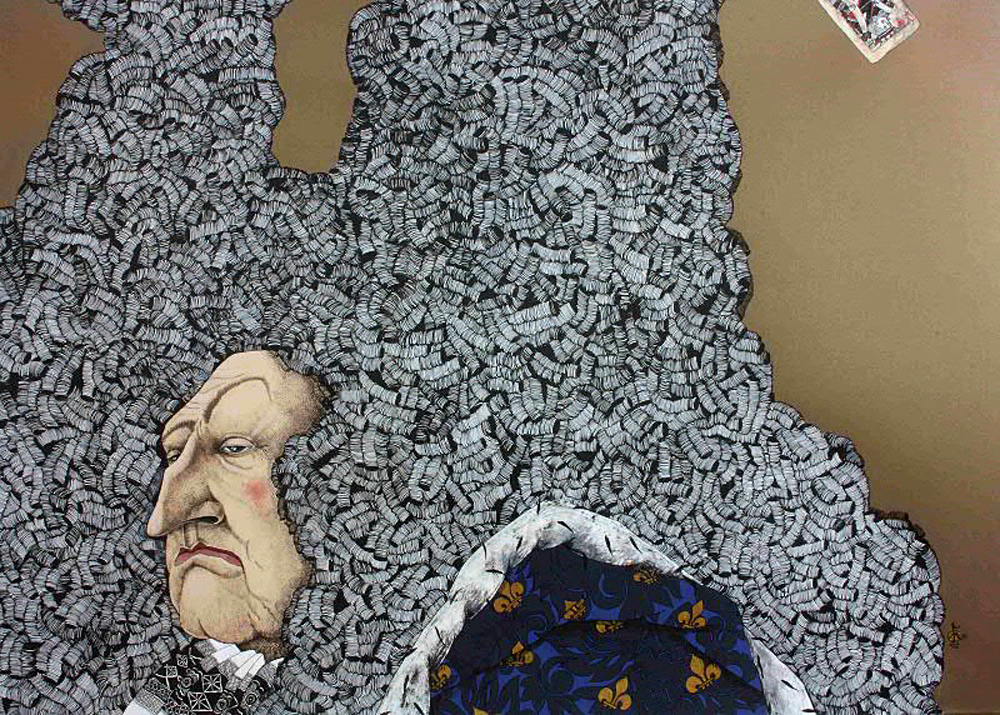
KL- 7 text“Lius XIV” Acrylic on Paper. (64 x 90 cm)

.

Ksenia Lavrova was born in Saint Petersburg in 1967. In 1990 she graduated from the Academy of Stieglitz (formerly LVHPU named after.V. Muhina). In 2005 she graduated from faculty sinology of the Oriental Institute.  Ksenia Lavrova is an artist with a wide range of creative skills. Active in various genres from design to book illustration, and graphic arts. Since 1994 she is a member of the Artists’ Union of Saint Petersburg. The artist Ksenia Lavrova lives and work in Saint Petersburg, Russia. 

.

EXHIBITIONS

Lavrova-2-Logo

Painting by Ksenia Lavrova in the exhibition of the Salon “Art Capital” 2015, (Paris).

.

Lavrova-Logo-1

Painting by Ksenia Lavrova in the exhibition of the Salon “Art en Capital” 2014, (Paris).

.

.

russian-b-2french-b-2gallery-b-2

.

.

.

.
Russian spelling: Художник Ксения Лаврова, (Санкт-Петербург)

.

.

.

.
“Russian Palette” in Paris 2013

ANNUAL MEETING WITH RUSSIAN ART IN PARIS “RUSSIAN PALETTE”.

From May 15 to 31, 2013 in 12 galleries in Paris, there will be art exhibitions representing Russian art in a variety of genres and styles – for the first time within the framework of the project “Russian Palette”, which promises to become an annual event thanks to the support of the Mayor of Paris, Mayor of the 8th arrondissement, the Russian Center of science and culture, as well as the monthly addition of Le Figaro Russia La Russie d’Aujourd’hui – an international project carried out since 2007 by the official daily newspaper of the Russian government, “Rossiyskaya Gazeta”. The Parisian gallery, regularly exhibiting Russian artists, offers a thematic route, which opens a wide panorama of art by contemporary Russian artists and artists of the XX century. Each gallery has its own concept, and thanks to this the palette of works is very rich: from figurative to abstract art, from sculpture and photography to installations.

From May 15 to 18, the participating galleries exhibited selected works from announced exhibitions at the Russian Center of Science and Culture in Paris.

.

Russian Palette 1The Russian Center of Science and Culture. 61 Rue Boissière, Paris

.

Russian Palette 2Director of the Russian Center of Science and Culture Igor Shpynov opened the vernissage.

.

Russian Palette 3 Lada Skachkova, the gallery “Russkiy Mir”; Max Laniado, Director of the gallery “Visio Dell’Arte”; Vladimir Kara, artist; Francine Szapiro, Director of the gallery “Saphir”; Paquita Escofet Miro, art collector; Serge Korzhakovsky, art critic (from left to right).

.

Russian Palette 4Francine Szapiro, Director of the gallery “Saphir”.

.

Russian Palette 5The exhibition hall.

.

Russian Palette 6Oskar Rabin, artist.

.

Russian Palette 7Part of exhibition.

.

Russian Palette 8Zurab Tsereteli, President of the Russian Academy of Arts.

.

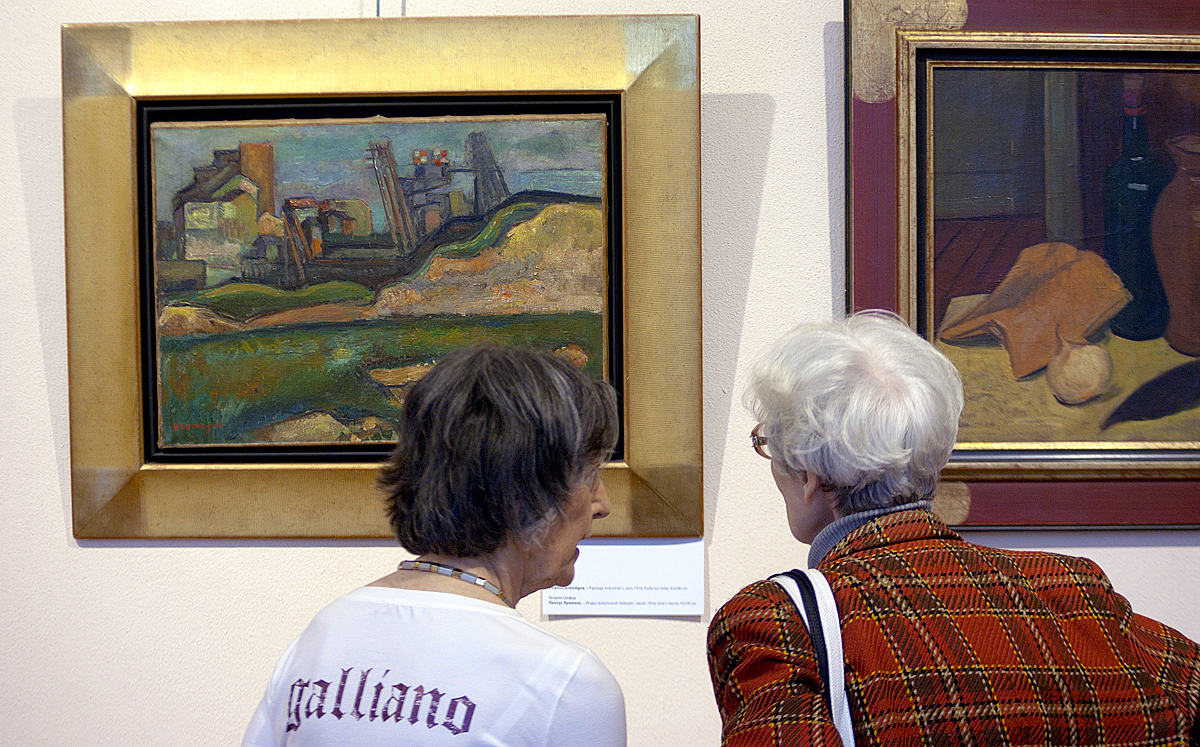
Russian Palette 10The viewers at painting.

.

Russian Palette 12Eugenia Miro, artist.

.

Russian Palette 14The glance. Eléonore Chalmin, (Auction House Daguerre Drouot) in front of the picture by artist Konstantin  Sutyagin.

.

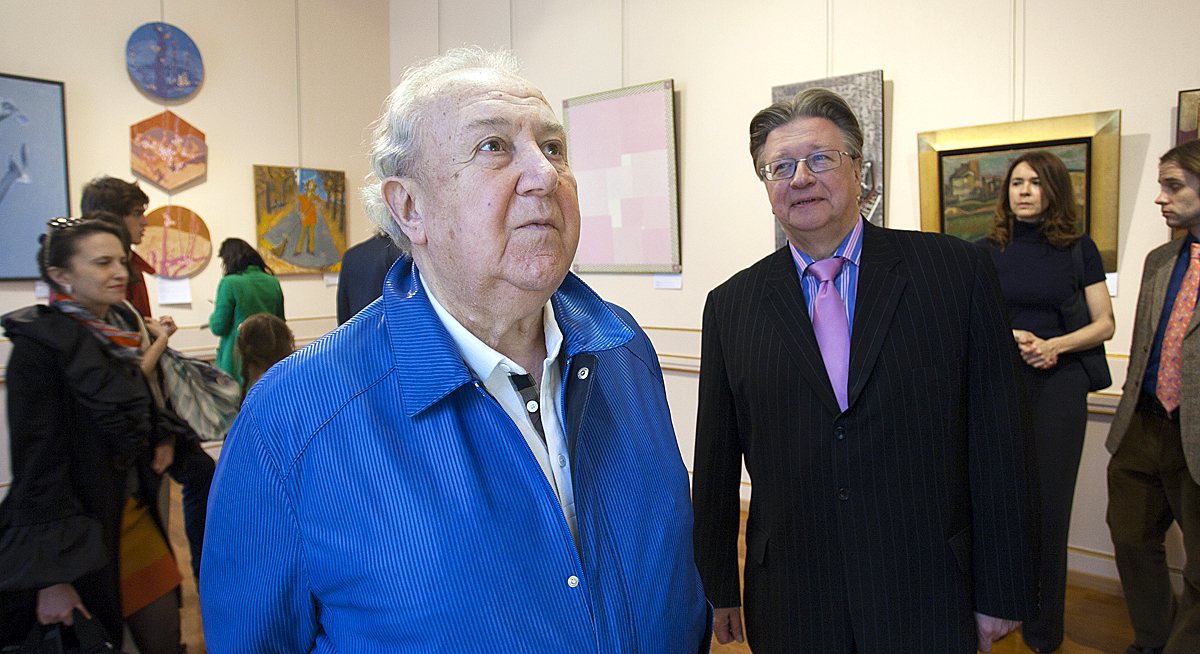
Russian Palette 13Max Laniado, Director of the gallery “Visio Dell’Arte”

.

Russian Palette 11Lada Skachkova, gallerist  and Vladimir Kara, artist.

.

Russian Palette 9Age of the digital revolution…

.

Photo essay by photographer Vladimir Bazan.

.

russian-b-2french-b-2

.

.

.

.

“Russian Art & Paris” Art Show. Spring’13

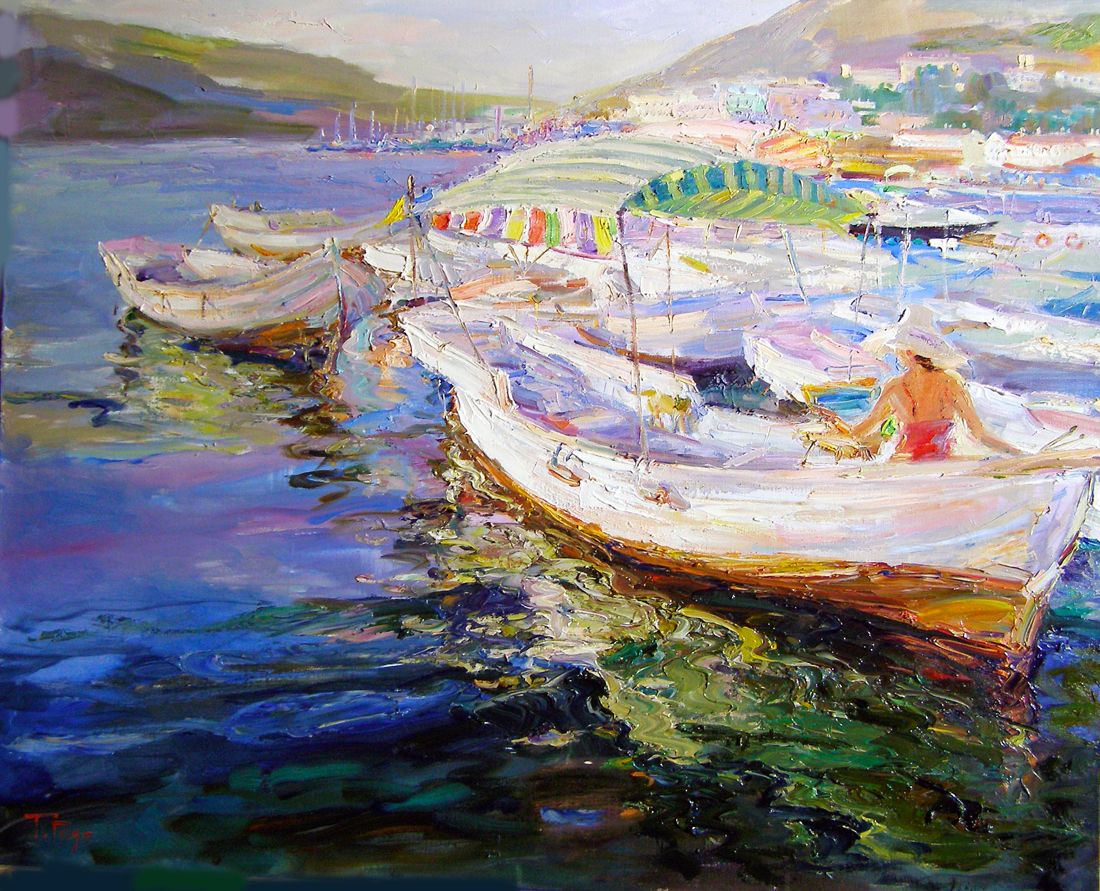
In the spring Art Show ’13 of the Russian Art & Paris journal, we present to our readers four contemporary artists. Tatiana Godovalnikova, a master of seascape from Sevastopol. A master of landscape Igor Grishchenko, Associate Professor of the painting of the Nizhny Tagil City Pedagogical Academy. Artist Mikhail Kaban-Petrov, is a well-known for the innovative character of the artistic quests. Dmitriy Permiakov, a young and very talented artist from Perm.  What unites these quite different artists is the originality of artistic thought and the bright distinctiveness of their pictorial language. For the attention of all who are interested in the world of contemporary visual art.

.

*  *  *

ARTIST TATIANA GODOVALNIKOVA, (SEVASTOPOL)

TG Por 2

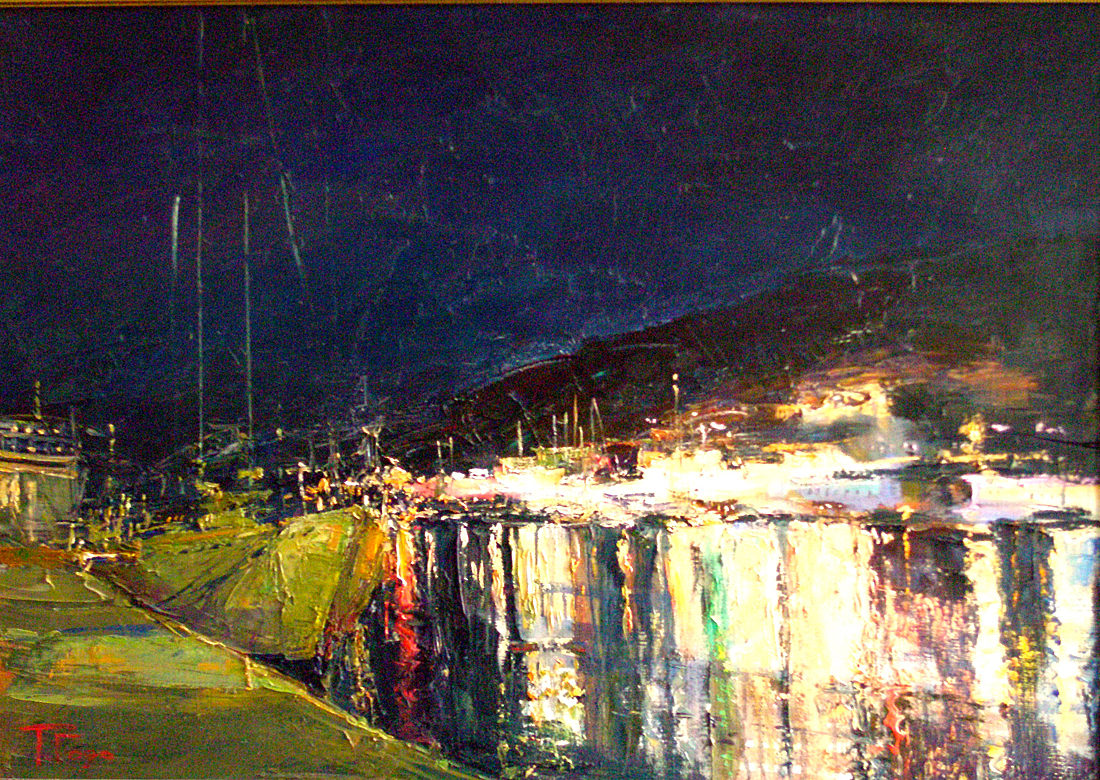
Impressionism, appearing more than a hundred years ago is a phenomenon both well-studied and rather mysterious. Very different artists have been labeled as impressionists. Different in style, in spirit, and, most importantly, in the the complex of their solvable tasks. In considering the work of the artist Tatiana Godovalnikova, it is very hard to resist from using the word “Impressionism”. The question is, what does this term give us in understanding the creative artwork of a single artist? Frankly, very little, almost nothing. Perhaps more interesting is the question, what is the major focus of the attention of this artist? Immediately, to the vague term Impressionism, we add a much more specific term – light,  the flow of light. The natural light stream is what makes up the compositional, and often the plot foundation of works by this artist. Light, whose plot function was noticed even by Vermeer, acts as a structure-forming element of the image in the works of T.Godovalnikova. The precise characteristics of the light stream, become a necessary condition for the creation of an authentic visual space. The magical aura of the artwork by T. Godovalnikova, the charm of the atmosphere of her works, are a natural consequence of the authenticity of the key compositional link – light.
•  Working with light, is one of the most interesting problems in visual arts. The theoretical principles of the luminosity of artworks have been developed long OLYMPUS DIGITAL CAMERAago, but the practical implementation of these principles require from the artist a very serious level of mastery. Tatiana Godovalnikova demonstrates fluency in the full range of light “palette”. The direct sunlight, creating a powerful major emphasis, is excellent in the landscape “Heat.” The subtle sound of pouring streams of light is in the painting “Wisteria”. The soft glow of a fading day is in the transparent evening landscape “Twilight.” The luminosity of these works, the accuracy and certainty of their tonal design is striking. In the still life painting “Roses on blue”, the light glare becomes the protagonist of the composition, building the theme and the plot of the work through its own arrival.
•  In the world of painting, the night landscape, and especially a landscape with water, is one of the most difficult scenes. Not every museum collection can boast of a successful night composition. The reasons are quite obvious – the technical complexity of working with nature on night scenes, and at the same time, the complexity of working in a studio with no credible and successful natural etudes. The landscape “Lights of Balaclava” can be safely attributed to the works of museum-grade. The fascinating atmosphere of a brightly lit coastal town at night; the relaxed composition of the painting, executed in a free style of painting – all speak about the work of a master. Accidental luck in works of such complexity simply does not happen.
•  The artwork of Tatiana Godovalnikova, reserved in the scenic range, is focused on the multidisciplinary development of favorite themes and motifs, is deeply professional and at the same time, artistic. And most importantly – this work continues …  ©

by Russian Art & Paris

____

Picture in the text: “Heat” Oil on canvas. (50 x 60 cm)

.

OLYMPUS DIGITAL CAMERA“Balaklava. Plein air”  Oil on Canvas. (70 x 80 cm)

.

OLYMPUS DIGITAL CAMERA“Lights of Balaclava’  Oil on Canvas. (70 x 100 cm)

.

OLYMPUS DIGITAL CAMERA“Roses on blue”  Oil on Canvas. (70 x 70 cm)

.

russian-b-2french-b-2website-4-rap

.

.
.

.

.

*  *  *

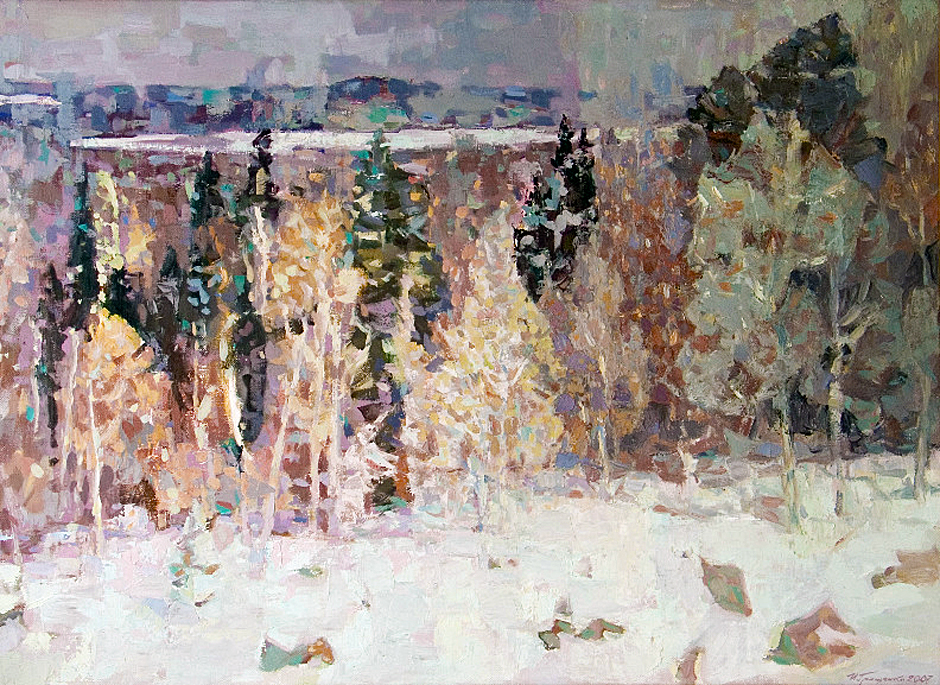
ARTIST IGOR  GRISHCHENKO,  (NIZHNY TAGIL)

I G Por 1

The depiction of wildlife, is habitually identified by the viewer with the word landscape. The artwork by artist Igor Grishchenko with its formal features, is very easy to attribute to this genre. With one small caveat – before us is not necessarily a landscape, but a feeling of a landscape, a recording of the artist’s emotions that arose from observing nature. Whether such an image can be called a landscape is a theoretical question. For the viewer, what’s more important is how interesting and significant is the image created on the canvas. Let’s start with the basics – what do we see once surrounded by the paintings of artist Igor Grishchenko? The coloristical  uniqueness of each painting, the lack of color repeats, is the first thing that is essential to notice. Each painting is characterized by a well-developed, almost musically sounding, color scheme. In most cases, a single color chord fills the entire plane of the visual space. Dissonances, strong color accents are almost nonexistent. Holistic, harmonious melody of color is the foundation of the artist’s scenic design. The decorativeness of a painting style should not be misleading, before us is a realism more authentic than many of the “photo-realistic” imitations of nature. Realism is not about external similarity, but rather about the meaning of the presented plot.
•  The impression prevailing over narration, is the hallmark of landscape compositions by the artist. The focus on transferring personal sensory experience can be seen in many paintings. The breath of a real living forest – “Landscape with a spruce”, “October”, “Spruce Forest”. Complex, emotionally rich compositions “Autumn,” “Northern Blues,” “Night Forest”. Intense drama in the paintings, “Blooming belogolovnik” and “Autumn Road”. The selectivity of the artist’s perception is confirmed by the well-structured, sometimes rigid, Golden Evening 1composition of each plot. The authenticity of these feelings and the prudence of artistic means to transmit these feelings, are probably the main features of painting by Igor Grishchenko. These main features involuntarily direct the viewer to the central question – what exactly transforms a canvas filled with paint into a painting? What components need to come together on the canvas to cause a work of fine art? The beginning of an answer to this question lies beyond the image’s plane, in the personality of the artist. Who is he, this mysterious man, who chose for himself a strange craft – of mixing colors? What is the essence of the craft – the ability to draw or the ability to see?
•  Landscape “Golden Evening”. Light-filled space. Golden glare of the sun at sunset. The stillness of evening sky. Tranquility. The meaning of this sensation is difficult to put into words, but no less difficult to convey with colors. The wooden palette of an artist contains no sunlight color, no warm evening air. The talent of an artist is the ability to think in categories of artistic ideas – color and rhythm, plane and volume. But to think also means to select, to analyze and understand. The last word – to understand – is probably key. Perhaps it is with this, that the road to a work of art begins. What exactly does an artist need to understand standing in front of a blank canvas: the construction of light and form, or the nature of his own feelings? Obviously, the former and the latter. What will be the most important – what you see or what you feel? What color combination will more accurately transfer the range of your own feelings? There are dozens of questions, and seeking the answers to them is the daily invisible part of the work of an artist. The viewer sees the result – the already discovered artistic image – glowing sky, golden glare, tranquility. Everything else remained “behind the scenes” in the studio of artist Igor Grishchenko.  ©

by Russian Art & Paris

____

Picture in the text: “Golden Evening” Oil on canvas. (58 x 78 cm)

.

Landscape with a spruce 1

“Landscape with a spruce’  Oil on Canvas. (80 x 100 cm)

.

Spruce Forest 1“Spruce forest”  Oil on Canvas. (75 x 110 cm)

.

Aspen mountain“Aspen mountain”  Oil on Canvas. (73 x 80 cm)

.

russian-b-2french-b-2website-4-rap

.

.

.

.

.
*  *  *

ARTIST MIKHAIL KABAN-PETROV,  (KOSTEREVO)

M. K-P por 1

The complexity of the assessments and the perceptions of contemporary art are in many ways linked to the orientation of the audience and the critics towards the generally accepted canons and artistic trends. The grading scale is thus attached to the present from the past. Roughly speaking, the definition of “what should be,” is willingly or unwillingly built on the assumption of “what was”. It would be interesting to ask art critics about how they see the future of fine art? And is it possible to also get an assessment of modern art based on the criteria of the future, not the past? The very question seems rhetorical at first glance – the example of empty cells in the periodic table is probably known to everyone. What is getting in the way? Perhaps there is a well-established view of art in society as one of the varieties of the service sector, which implies adherence to the aesthetics of today. This is not true. Fine art does not engage in the servicing of aesthetic needs. Its purpose and scope are in a completely different field. As an illustration, let’s take a look at the work of one of the modern masters.
 •  In the upside down world of the painter Mikhail Kaban-Petrov, everything is very similar to the truth. The inverted boat that will not float because of winter (“Boat”). And will the thawing ever come, and with it the pure water on which you can float, no one knows. Perhaps the thawing will never occur and the boat will not float ever. Is that not true? A door, remarkable in that it is closed (“Door”). Light makes its way under the door – there is someone, there are people, there is life, there people are “… again, not sleeping. Maybe drinking wine, maybe sitting around. “(M.Tsvetayeva). But we, the audience, and the artist himself, are on this side of the door. Will we be able to get to where the Rekviemlight is? Maybe yes, maybe no. “Heat,” where there are two people noticeably present, although neither are in the plane of the image; and from the outside world there only remains a red-hot streak of light making its way out of a curtained window. There is no life, only the emptiness of heat. The life in here, in this room, and what we see, is but a fragment. A fragment reinterpreted in the artistic space of a canvas. What kind of artwork is this? What is its essence? First of all in this remarkable truth, is a feature invaluable to art – uniqueness, as the Parthenon is unique, despite the abundance of marble.
 •  The artwork of M. Kaban-Petrov is far from symbolism, it contains no set of metaphors. The nature of this painting is deeply national – there is more Dionisy in these canvases than Cezanne. The style of paintings by M. Kaban-Petrov is associated with black and white “graphics” of the novels by Dostoevsky. “Requiem”, is made in a “negativity” form that is very unexpected for an artistic painting. “Prayer”, with a tragic red color and the no less tragic “The Wall”, show an inner spiritual relationship with the major themes of Dostoevsky.
•  The realism of the perception of the surrounding world, the understanding of the world as an objective reality, is materialized in the artistic reflections on the content and meaning of this reality. What we see in artworks of Mikhail Kaban-Petrov, is not just a glance from the side at our present reality, but a glance at it from a different time. A glimpse from the future. This is how our time will look, the part of it that went into the field of view of the artist, through the eyes of future generations of viewers (and joining them, art critics).  ©
.
by Russian Art & Paris
.

____

Picture in the text: “Requiem” Oil on canvas. (122 x 90 cm)

.

lodka 1“Boat”  Oil on Canvas. (80 x 102 cm)

.

natur“Still life”  Oil on Canvas. (135 x 85 cm)

.

kniga“Book”  Oil on Canvas. (115 x 76 cm)

.

russian-b-2french-b-2website-4-rap

.

.

.

.

.
*  *  *

ARTIST DMITRY PERMYAKOV,  (PERM)

D.P POR 1A thirty years old artist on the current practice is considered young. This is natural, the period of training in fine arts is long and not limited to the years of formal education. Confident independent creative work, in most cases, only begins after thirty. In other words, the thirty-year-olds are the newest generation in art. The interest of the public to this generation is obvious, a new generation means a new look at the world, with their new understanding and new emotions. The creative work of artist Dmitry Permyakov, one of the representatives of this generation, bears many of the basic characteristic features of Russian painting. This is a traditionally high level of color culture, mastery of art composition, and an understanding of its role in creating an artistic image, this is also the attention to the everyday life surrounding the artist. But there are others who also have all this, entering the world of professional fine art as young and certainly talented artists. What distinguishes this particular artist? Let’s take a closer look.
•  The subtle coloristical intonations of the artistic constructions by Dmitry Permyakov attract attention at the very first acquaintance with his canvases. The artist avoids rough color-dominants. A precise coloristic tune is built without the help of accents, with maximum use of the effect of color harmony. Modest in size, “Ural sketch” demonstrates the unusual intonation quality of paintings by D. Permyakov. A soft, planar sketch, what could be so special about it? Particularly the tone, is what creates an emotionally expressive Уральский этюдartistic image. The seen, heartfelt intonation is carefully preserved even in large, studio-landscape compositions (“Barents Sea”, “Montenegrin Ples”). The flawless tonal range, without which it is impossible to work in the model of “landscape-state”, creates the basic, tangible medium of the artistic space of the image’s plane. Restraint, at times austerity in working with color, is evidence of not only talent, but also of the real artistic maturity of the author.
•  In a dramatic, landscape in form, composition with it’s title sounding like a line from a letter: “Everything is fine”, suddenly and brightly sounded the genre painting’s note, a phenomenon not entirely familiar in today’s landscape painting. At the same time, the boundary between the traditional artistic genres is the area where the most interesting discoveries and creative successes of contemporary artists are concentrated. This is, relatively speaking, the interpenetration (convergence) of the genres, so the value of artistic ideas – the reason for which the “bridge” is thrown from one genre to another – is the key. The painting “Everything is good” is an example of a clear and convincing artistic idea, which lays the foundation for the plot-motivated image. The obvious attraction of Dmitry Permyakov towards studio landscape, deserves serious consideration. Success in this field is determined not only by the quality of artistic ideas, but also a high level of stylistic individuality of the artist. These are not easy tasks, but the talent Dmitry Permyakov is worth us wishing him good luck! ©

by Russian Art & Paris

____

Picture in the text: “Ural sketch” Oil on canvas. (21 x 23 cm)

.

все у нас хорошо 2

“Everything is fine”  Oil on Canvas. (105 x 130 cm)

.

_Mysterious May“Mysterious May”  Oil on Canvas. (60 x 55 cm)

.

Barents Sea“Barents Sea”  Oil on Canvas. (80 x 95 cm)

.

russian-b-2french-b-2website-4-rap

.

.
.

.

Editorial

ATTENTION RUSSIAN ART & PARIS READERS:

Our next publication – “ArtShow Spring’13″ – will be online on Saturday,  May 4th. 

International Artexpo 2013, (New York)

THE EXHIBITION OF THE ARTEXPO NEW YORK 2013,  MARCH 21-24

International Artexpo is the world’s largest fine art trade show, providing dealers, collectors and buyers with access to thousands of innovative works from artists and publishers in one single venue. Over its 35-year history, Artexpo New York has hosted many of the world’s most renowned artists, including Andy Warhol, Peter Max, Robert Rauschenberg, Robert Indian, Keith Haring and Leroy Neiman. With attendees from all over the world, Artexpo New York hosts the largest gathering of qualified trade buyers, including gallery owners and managers, art dealers, interior designers, architects, corporate art buyers, art & framing retailers and many others. From Europe to the Far East and South America, Artexpo hosts an international audience of industry professionals seeking to discover exciting new works from AE 13-text-1AE 13-text-2-2AE 13-text-4established and emerging artists.

Dear Friends:
It is a great pleasure to welcome everyone to the 35-th Anniversary of Artexpo New York City. With more than 500 galleries and 150 world-class museums, New York is the place to be in the global arts scene. Our unparalleled arts institutions and the many talented artists who live and work here embody the creativity and innovation that defines our City, and that is why we are delighted to lend our support to the Artexpo, the largest fine art trade show in the world. This exciting annual event connects art dealers, collectors, and buyers with some of the best international artists and publishers, while also showcasing works from the top emerging artists and offering seminars on a wide range of topics. We applaud the Artexpo for contributing so much to our cultural landscape and look forward to New York remaining a premier destination for artists and art lovers alike in the years to come. On behalf of all New Yorkers, I am delighted to welcome everyone attending this year’s show to our City, and I hope you have the chance to explore our diverse neighborhoods and experience the many exciting attractions that define our five boroughs. Please accept my best wishes for a wonderful event and continued success.
Michael R. Bloomberg,
Mayor of New York City
.

Piers 92/94, a premier trade show and special event venue in the heart of Midtown Manhattan, 55th Street and the West Side Highway. Piers 92/94 is home to design oriented events such as The Artexpo New York, The Armory Show, Architectural Digest Home Design Show, The Pier Antiques Show and leading fashion shows during New York Fashion Week. The facility also regularly host parties and product launch events for groups ranging in size from small charitable foundations to Fortune 500 companies. No matter your event needs, Pier 92 and Pier 94 enjoy a prime location, as well as established prestige in the New York convention and special event landscape. 208,000 square feet of exhibit area make Piers 92/94 the second largest facility in New York City. Connected by a spacious and welcoming headhouse, Pier 94 offers 133,000 square feet and Pier 92 features 75,000 square feet of contiguous exhibit or event space. Open space, high ceilings and column-free corridors create unlimited configurations and adaptable spaces.

.

AE13-xAn early morning in New York. Artexpo parking lot on the roof of “The Art Pier”.

.

AE13-2Artexpo parking lot on the roof of the Pier 90.  “Carnival” is a American global cruise company, and the world’s largest cruise ship operator.

.

AE13-3The Pier 90. The yacht “Eclipse” is the world’s largest private yacht. The owner is Russian businessman Roman Abramovich.

.

AE13-4Artexpo New York 2013. The entry hall.

.

AE13-5Artexpo New York 2013. The lobby.

.

AE13-6Artexpo New York 2013. The exhibition hall.

.

AE13-8Artexpo New York 2013. The Gallery Pavilion.

.

AE13-10The Gallery Pavilion. Artworks and viewers.

.

AE13-9The Gallery Pavilion at the beginning of exhibition.

.

AE13-aArtexpo New York 2013. The galleries exposition.

.

AE13-16The galleries exposition.

.

AE13-15Viewers at an artwork.

.

AE13-11An afternoon time.

.

AE13-12Painting and viewers connection.

.

AE13-13There are many styles and topics…

.

AE13-14…for every viewer.

.

AE13-18Inside the Gallery Pavilion.

.

AE13-19A lot of artworks.

.

AE13-17Video advertising is part of modern presentation.

.

AE13-25The exhibition at noon.

.

AE13-26Discussion inside a gallery section.

.

AE13-24Viewers and buyers.

.

AE13-27Russian painting in Tatyana International Art, Inc. booth.

.

AE13-zGallerist Tatyana Cohen (Houston, USA) introduces many excellent Russian artists to New York public at Artexpo 2013.

.

AE13-20Art dealers and traders.

.

AE13-29Contemporary art viewers.

.

AE13-21The print section.

.

AE13-22…to buy or not to buy?

.

AE13-30Viewers in the SOLO Pavilion.

.

AE13-34The SOLO Pavilion. Viewers at artworks.

.

ArtExpo13-4Artexpo CEO Eric Smith with Larisa Fayvisovich at artist Aleksandr Fayvisovich booth.

.

AE13-23From 10 am till 7 pm there are viewers, traders, and buyers…

.

AE13-yThe end of a day.

.

AE13-35An evening on the West Side.

.

.

.

.